

The Complete AI Workflow
For Engineering Simulation
From data generation for AI training - to building AI models, deploying them, and optimising designs with them.
DEP AIWorks maps to your entire product development process. Built by practicing CAE engineers.
Physics-Informed Neural Networks (PINN) · Predictive AI · Generative AI ·
Agentic AI · Patented Voxelation · Built-in MDO
What is AIWorks?
The AI Workflow No Framework Gives You
AIWorks is not a standalone AI tool. It is a complete, workflow-based platform that covers the entire AI lifecycle: generating the data needed for AI training, building and validating AI models, deploying them as fast solvers, and optimising designs with them.
Physics - Informed. Problem - Class Tuned
At the core of AIWorks is our Physics-Informed Neural Network (PINN) technology. Unlike standard ML, AIWorks embeds the actual governing physics - finite element equations, Navier-Stokes, Large Eddy Simulation - directly into the neural network training loss. Separate PINN architectures for mildly, moderately, and highly nonlinear problems.
Proven at Scale. Deployed & Tested. In Production
AIWorks is not a research prototype. It is deployed in active engineering programmes at major automotive OEMs, aerospace programmes, and Tier-1 suppliers globally not evaluation pilots. Multiple disciplines. One platform.
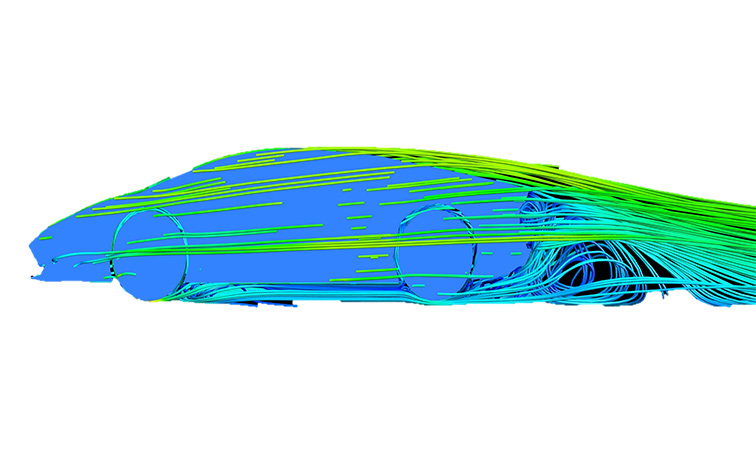
Aero/Drag
Crash/Side Impact
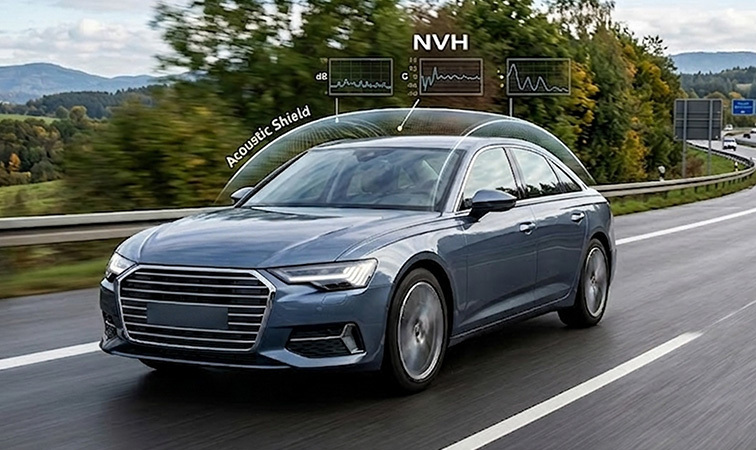
NVH Trimmed Body
Globally Completed
All accuracy figures validated against real customer simulation data - not benchmark datasets. Equivalence scoring provides per-prediction confidence before any AI result is used in a design decision.
See  in Action
Download the DEP AIWorks Technical Brochure
Get the complete overview of AIWorks - including module capabilities, PINN architecture details, validated accuracy benchmarks, and real customer proof points across automotive, aerospace, and heavy equipment programmes.
Architecture
Simulate-AI
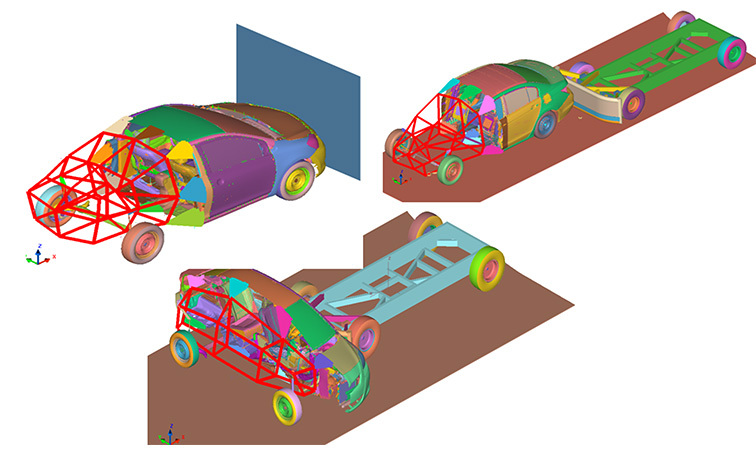
Physics-Informed Neural Networks (PINN) replace costly solver runs. Trained per load case with physics equations - Navier-Stokes, finite element equations, and LES - embedded directly in the training loss function. Predicts scalars, time-history curves, and full 3D field contours. Delivers <3% prediction error on aerodynamic drag and body stiffness, and 95%+ R² on highly non-linear crash responses. An equivalence score validates AI model confidence before any prediction is used in a design decision.
Features-AI
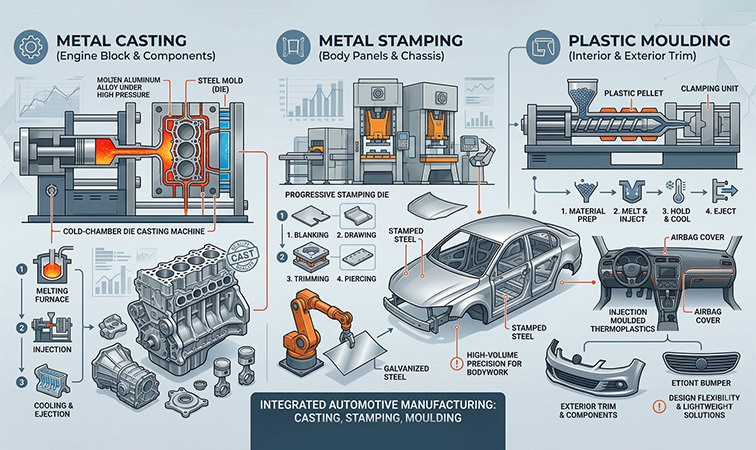
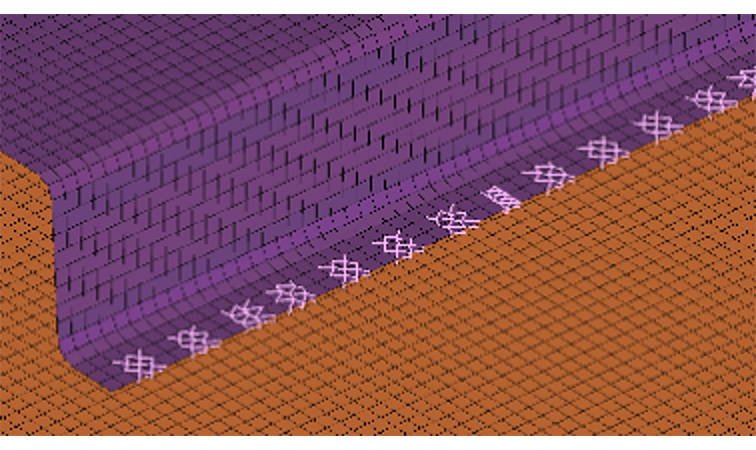
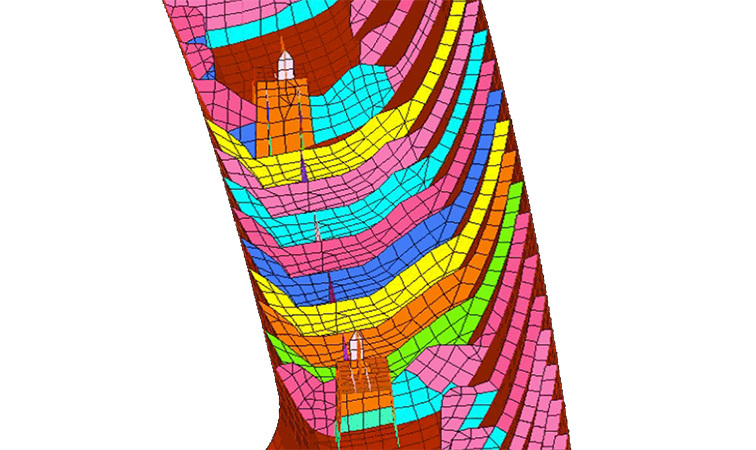
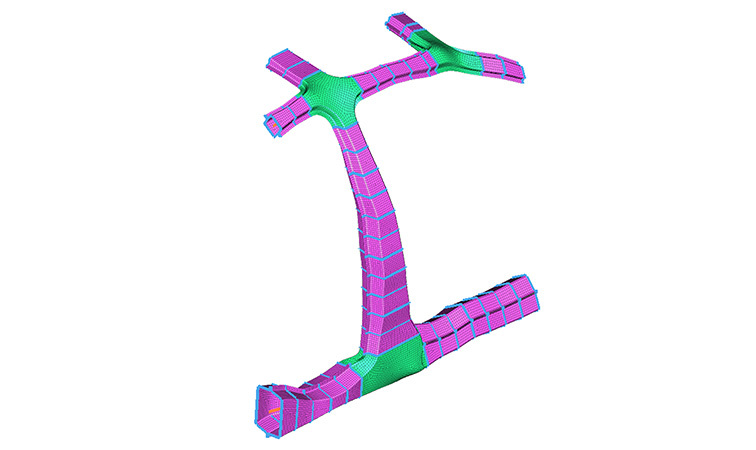
Machine intelligence for geometry feature recognition across complex assemblies - automatically identifying ribs, bosses, fillets, spot welds, MIG welds, holes, and flanges directly on finite element models. Converts recognised features into smart parametric handles, enabling rapid new design creation and AI-assisted concept generation without returning to CAD. Drives mass training-data creation for downstream AI workflows. Supports casting, stamping, injection moulding, and welded assembly geometries.
GEOM-AI
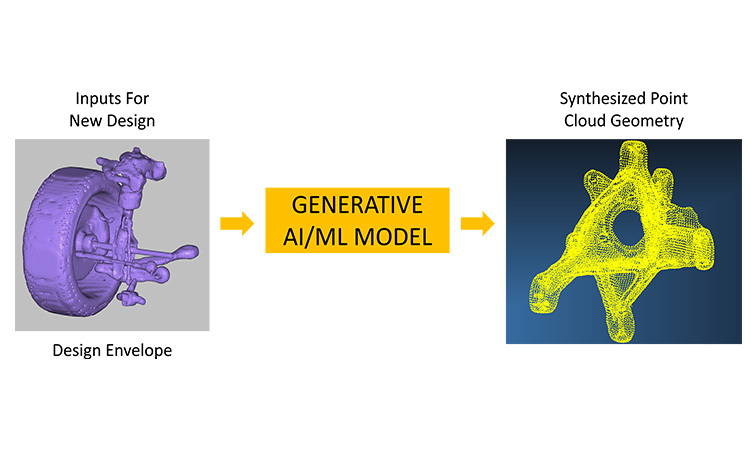
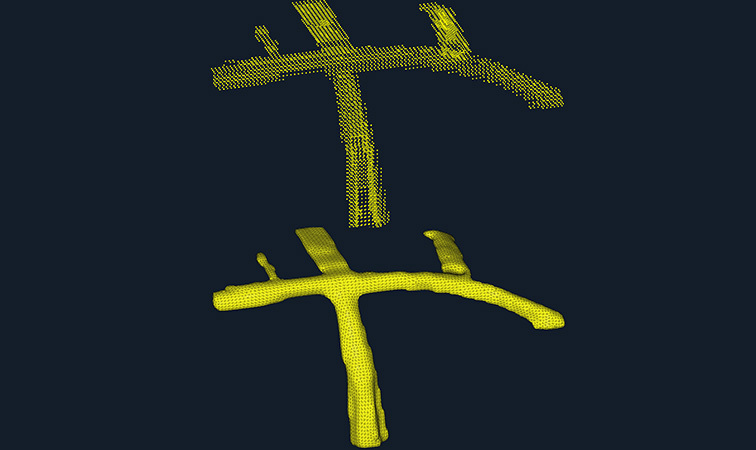
AI-driven generative geometry meets instant re-prediction. Modify a CAD shape through morphing - change a spoiler angle, roof curvature, or panel profile — and receive an immediate AI-predicted performance response, with no re-meshing and no solver queue. Results in seconds. Includes automated sub-model generation for local design iteration, generative topology creation at mesh level (new parts without returning to CAD), and Digital Twin creation by mapping manufactured scan data - including geometry, thickness variation, pre-strain, and distortion - onto nominal FE models for true as-built simulation.
Agentic-AI
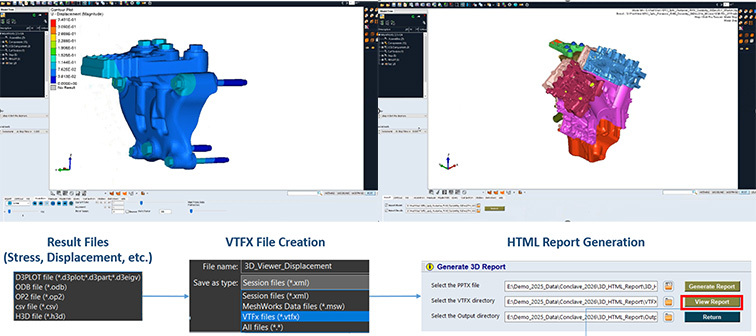
Autonomous simulation agents that orchestrate complete, multi-step CAE workflows without constant engineer supervision. Agentic AI intelligently routes tasks between physics solvers and AI surrogate models based on runtime requirements and the availability of trained AI models. Capabilities include multi-solver orchestration, autonomous overnight optimisation loops, multi-discipline variable synchronisation across crash, NVH, stiffness, and CFD, and auto-generation of 3D-embedded reports on workflow completion. The engineer remains in control and Agentic AI acts as a co-pilot.
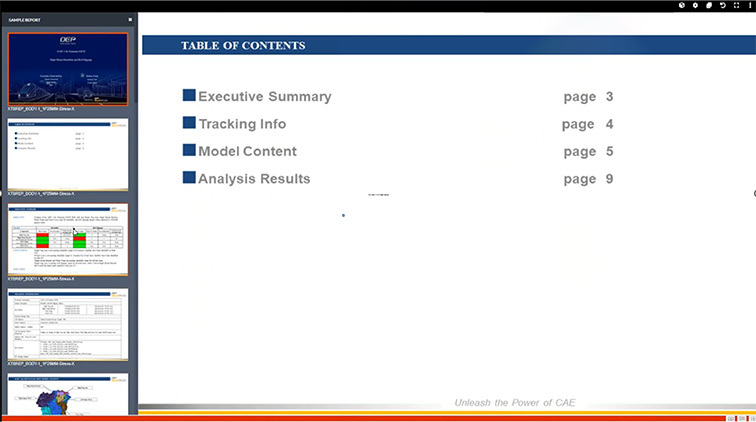
VALIDATED ACCURACY
Real Solvers. Real Customer Data. Real Results
Every figure benchmarked against production solver runs - not curated datasets.
Aerodynamic drag prediction
Multiple body configurations . full-vehicle external flow
Prediction accuracy vs. solver baseline
Body torsion & bending stiffness
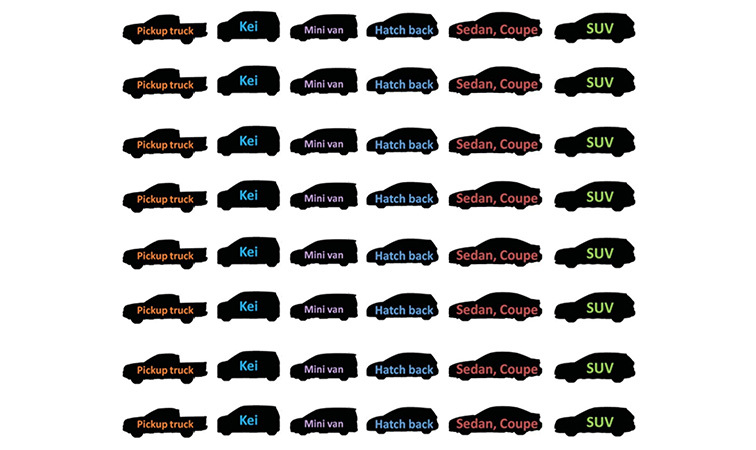
BIW load cases . multiple vehicle architectures (90+ variants)
Prediction accuracy vs. solver baseline
Side impact - highly non-linear
B-pillar acceleration time history . multiple load paths
Correlation coefficient vs. full solver run
Natural frequency prediction
Multiple wheelbases roof configurations. trimmed body
Frequency prediction vs. solver baseline
Ready to see it in your workflow?
See AIWorks live - with your data, your solver, your load cases.
The Complete AI Simulation Pipeline - In One Platform

Data Creation
Generate hundreds of simulation-ready variants from one baseline - without returning to CAD
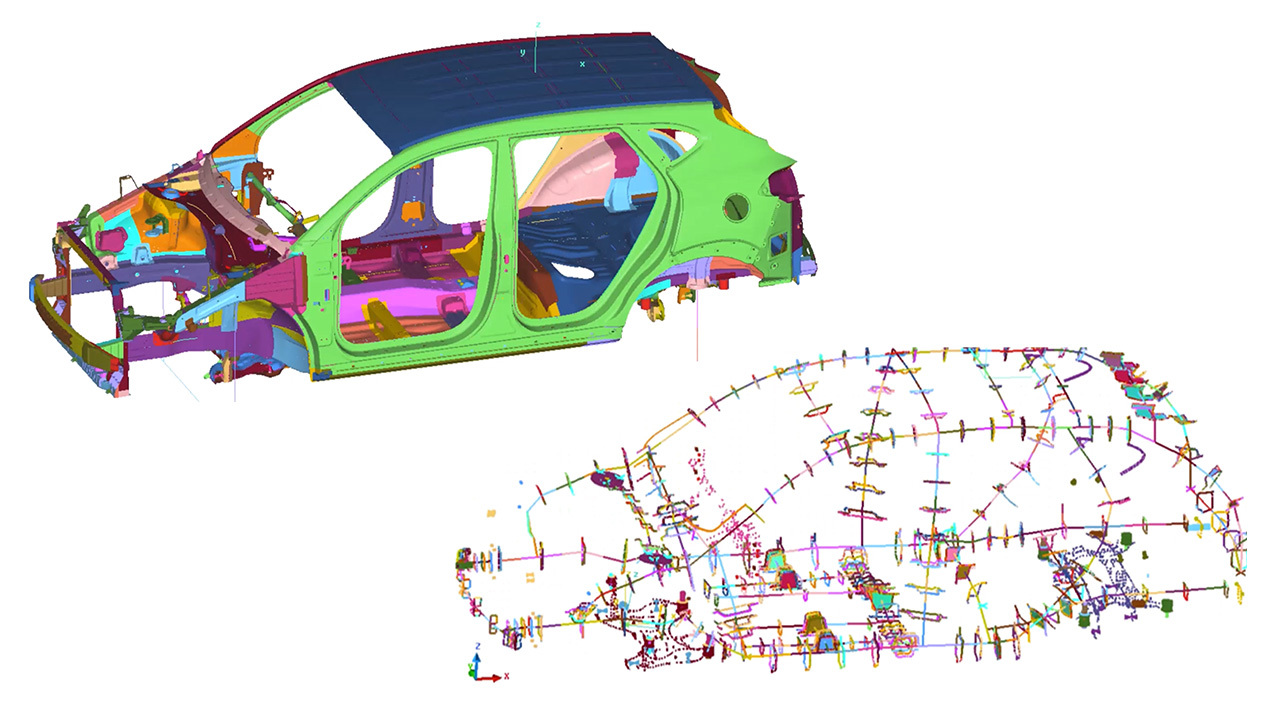
What it does?
Parametric FE changes, morphing, and concept modelling create diverse geometry, thickness, and material variants at mesh level.
ROM runs the variant population fast - compressing solver time from days to hours - feeding a rich AI training dataset.
Why it matters?
Every AI model is only as good as its training data - most organisations don't have enough of it.
Other platforms assume the data pipeline is already solved. AIWorks builds it.
250+ Crash models from 1 baseline vehicle - zero CAD rework.
Data Analysis
Statistically map geometry, thickness, and results across hundreds of models - before training begins
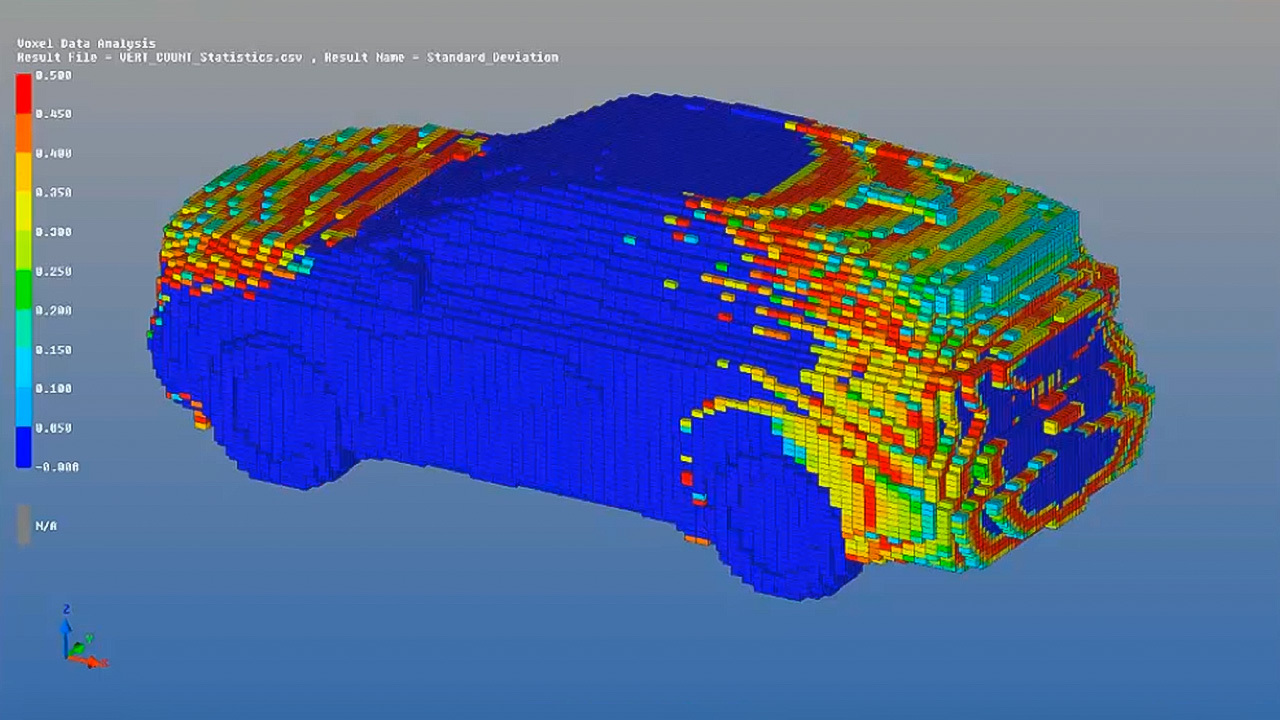
What it does?
Patented Voxelation robotically scans all variants and places them in a common 3D space - geometry, thickness, material, and result data mapped statistically.
Surfaces cause-vs-effect design intelligence across the full population - inputs and outputs - without loading individual files into memory.
Why it matters?
Loading 100 solver models conventionally is impossible
AI model quality is determined here - before a single training epoch runs.
The only platform with a statistical design-space analysis engine as a native pre-training step.
PINN Training
Physics embedded in the training loss - FE equations, Navier-Stokes, LES - not bolted on after the fact
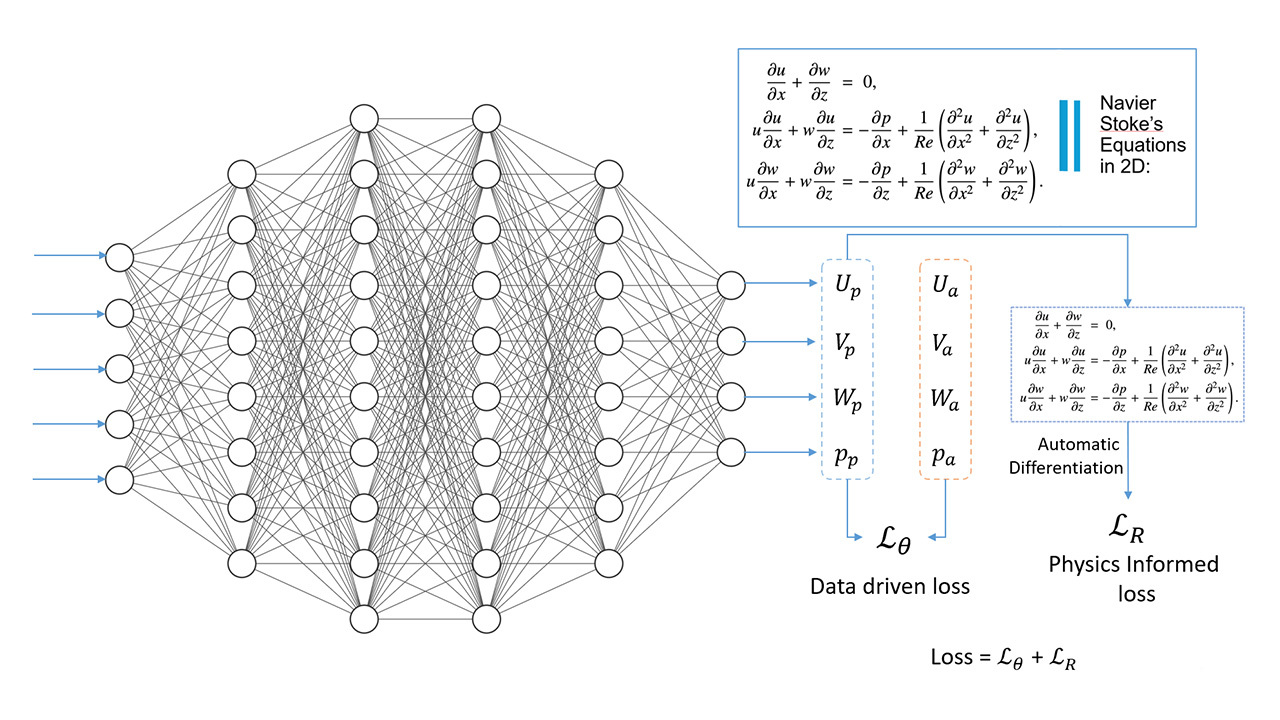
What it does?
Separate neural network architectures per problem class - mildly, moderately, and highly nonlinear - each with matched physics equations in the loss.
Adaptive per load case. Equivalence scoring calibrated during training to set the model's confidence boundary before deployment.
Why it matters?
Standard ML extrapolates blindly beyond training data - a silent failure in engineering simulation.
Physics in the loss forces the network to respect governing equations, enabling accurate extrapolation on new geometries.
Three problem-class architectures - mildly, moderately, highly nonlinear - each physics-tuned.
AI Model Family
Three models per load case - predictive, generative, and a confidence scorer - from a single training run
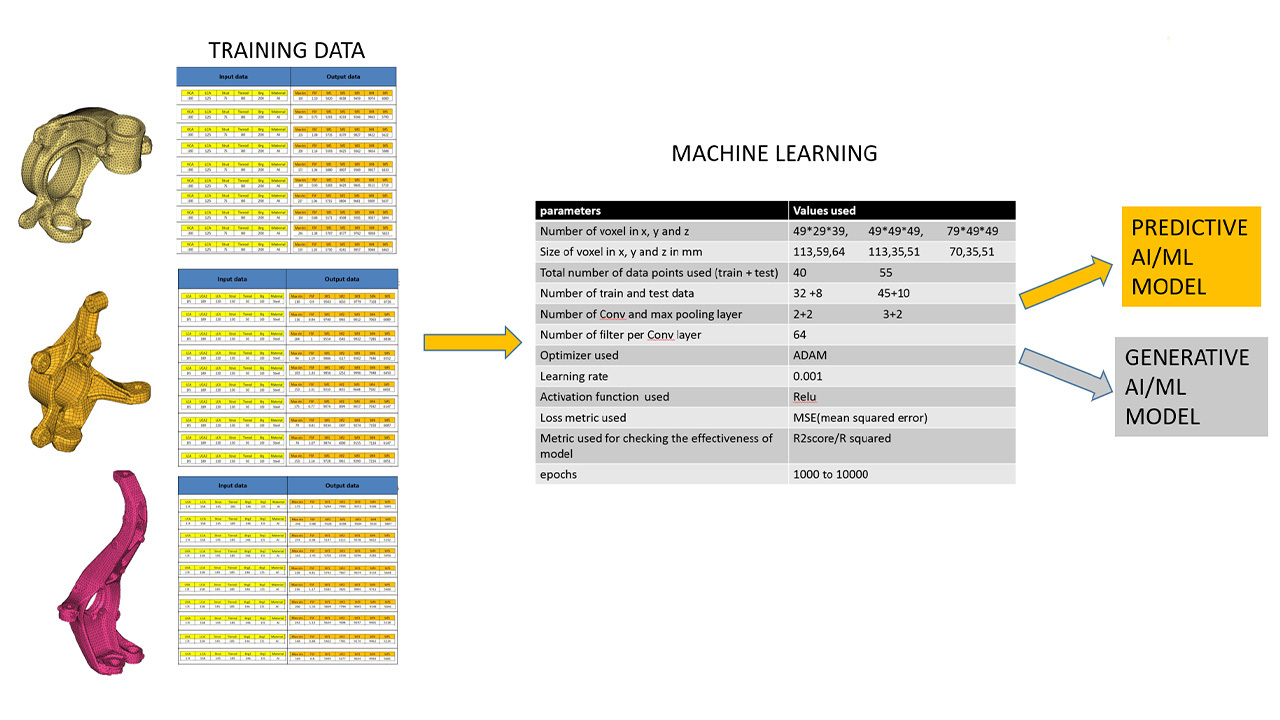
What it does?
Predictive AI replaces the solver. Generative AI works like a topology optimizer. Equivalence Scorer rates prediction confidence before use.
All three produced automatically per load case - high score means act on it, low score flags the result and invokes the solver.
Why it matters?
Prediction tells you what. Generative tells you how. The scorer tells you whether to trust it - all three are needed to act on AI results safely.
Without the scorer, there is no signal when a design has drifted outside the reliable prediction envelope.
The Equivalence Scorer - the trust mechanism no competing platform provides - tells engineers exactly when to rely on AI and when to invoke the solver.
Predict
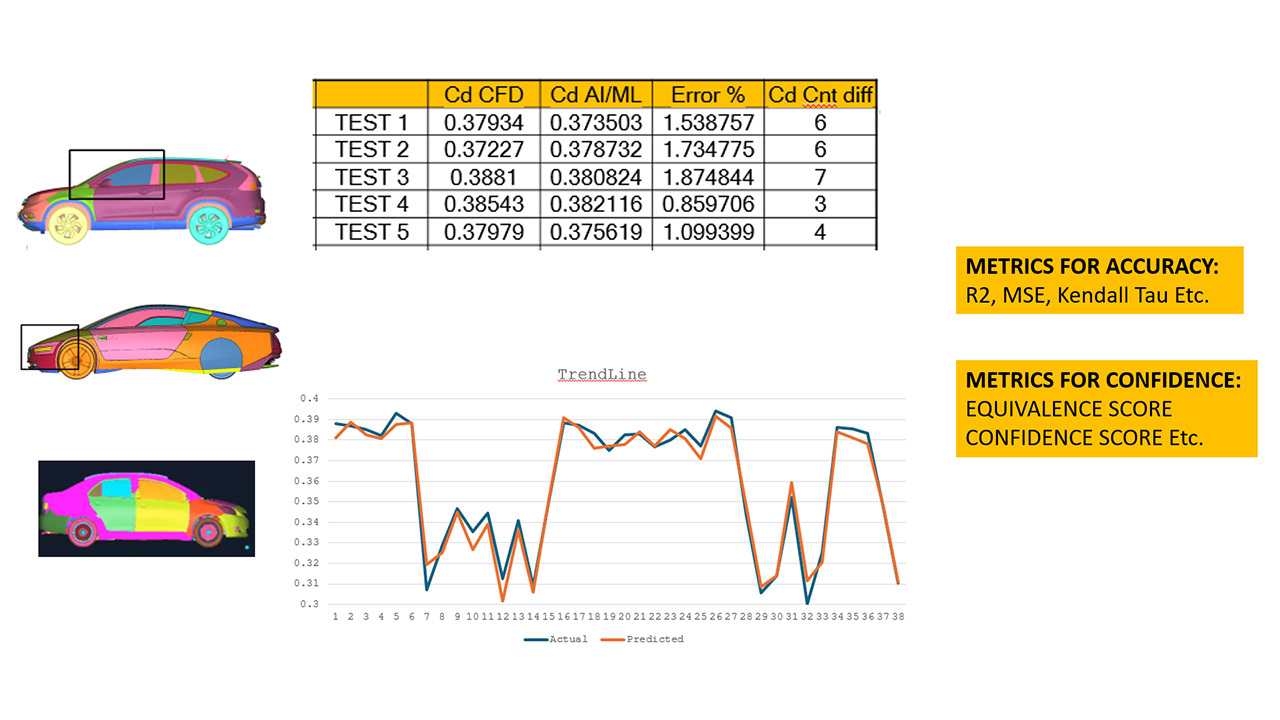
Stress, frequency, drag, displacement - scalars, curves, and full 3D fields - in seconds, not days
What it does?
Predicts scalar, vector, and full 3D field responses - stress, pressure, frequency, displacement - for any new design without a solver run.
Equivalence score runs per prediction - AI surrogate or physics solver invoked automatically based on confidence level.
Why it matters?
AI prediction removes the solver queue as the design bottleneck.
Computational cost reduced by orders of magnitude - without sacrificing engineering rigour.
<1% drag error. Full 3D pressure field, not just scalar CD. 95%+ R² on crash model solver time-history. Highly nonlinear side impact.
Optimize
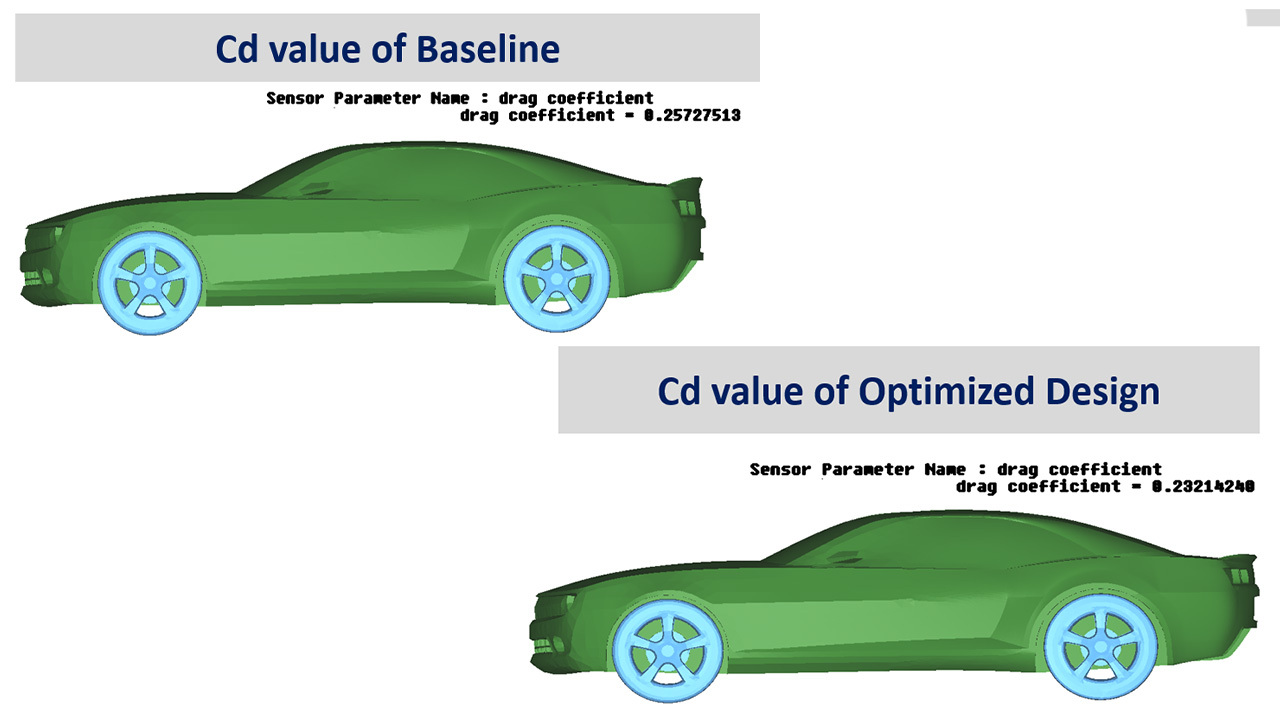
MDO across crash, stiffness, NVH, CHT, and CFD simultaneously - AI or physics solver, chosen automatically
What it does?
Parametric variables linked directly to the MDO loop - crash, stiffness, NVH, CHT, and CFD driven simultaneously in one run.
Agentic AI executes overnight loops - monitors, switches between AI and solver per response, and auto-reports on completion.
Why it matters?
Sequential single-discipline optimisation misses trade-offs - the best crash design is rarely the best NVH design.
Simultaneous MDO with automatic AI-vs-solver switching is what makes multi-discipline optimisation feasible at engineering scale.
Built-in MDO - Crash · NVH · CFD · Stiffness · CHT in one loop, inside AIWorks.
Data Generation Leadership
AI is Data Hungry. AIWorks Solves That.
Every AI surrogate model - regardless of the platform it is trained on - is only as good as the data behind it. Most engineering organisations, even large OEMs, do not have hundreds of labelled simulation variants organised and ready for AI training across every load case. AIWorks solves this at the source. Using DEP's parametric CAE, morphing, concept modelling, and Reduced Order Modelling (ROM) capabilities - integrated within the MeshWorks platform - you can generate hundreds of simulation-ready variants from a single baseline model, without returning to CAD. The ROM engine then runs those variants fast, compressing days of solver time into hours. The patented Voxelation engine analyses the resulting design population statistically before AI training begins. Data generation → statistical analysis → AI training → deployment. All in one platform.
1
Baseline Model
Single FE/ CFD
100+
Variants
Parametric + morphing
✔
AI-ready Dataset
No CAD rework
PINN
Model Trained
Per load case
DEP AIWorks Technical Brochure
The full technical case - ready for your engineering review. Module capabilities, PINN architecture, solver-referenced accuracy benchmarks, and customer programme evidence — compiled for your team's technical evaluation.
Why AIWorks Leads
The Platform Others Build Components Of. AIWorks Delivers Whole.

The Only Platform That Solves The Data Problem
AI tools need training data. Generating that data - hundreds of validated simulation variants from a single baseline, without returning to CAD - is the problem every other platform leaves to you. AIWorks solves it before training begins, using DEP's parametric CAE, morphing, concept modelling, and ROM capabilities - all integrated within the same environment.

Physics Tuned To The Problem Class
AIWorks uses separate PINN architectures tuned for mildly, moderately, and highly nonlinear problems. A crash simulation gets different physics treatment than a frequency analysis - because they are fundamentally different physics. This is the technical reason for <3% aero drag error and 95%+ crash R², validated against production solver runs, not curated benchmark datasets.

Deployed by Engineers - Not Assembled By Developers
AIWorks is operated by simulation engineers - not built by data scientists for later use by engineers. Your CAE team connects to their existing solvers and runs the full AI workflow from day one. Proof-of-concept in under six weeks.

Patented, Vertically Integrated - Not A Stitched Toolchain
Voxelation-based data analysis. Problem-class PINN architectures. Real-time morphing with instant AI re-prediction. Digital Twin mapping from manufactured scan data. These are DEP-developed, patent-protected technologies - not third-party integrations. The platform is vertically integrated by design, and that is why it works as one system.
Deployed Across Every Engineering Vertical
Automotive
Aerospace & Defence
Railways
Energy, Oil & Gas
Healthcare
Heavy Equipment
Consumer Electronics
Industrial Machinery
Built for Every Simulation Engineer
CAE / FEA Engineers
Structural, crash, durability, and fatigue specialists can replace multi-day solver runs with sub-minute AI predictions across multiple load cases simultaneously.
CFD / Thermal Engineers
Aerodynamics, CHT, and cabin comfort engineers can do drag prediction in 2 minutes vs. 3-week CFD queue. 3D pressure field results generated on demand for new styling geometries.
Simulation Team Leads
Engineering managers can build AI-ready CAE organizations - from data strategy and model governance to agentic workflow deployment at scale across multiple product lines.
CAD / Design Engineers
Product designers can use GEOM AI to morph geometries and re-predict performance in real time - closing the loop between styling and simulation on the same day.
NVH / Acoustics Engineers
Trimmed body frequency optimization, acoustic performance improvement achieved with - AI-predicted natural frequencies at sub-5% error across wheelbases and roof configurations.
AI / ML Engineers in Industry
Data scientists applying ML to physical simulation data can leverage DEP's pre-trained PINN architectures tuned specifically for mildly, moderately, and highly non-linear engineering problems.
See AIWorks live
Your load case. Your solver. Your geometry. Our engineers.
Request a personalized 45-minute technical demonstration - not a generic product walkthrough. We will show you exactly where AIWorks fits your workflow and the accuracy you can expect from day one.