
Accelerating Consumer Goods & Electronics Innovation with AI-Powered Digital Engineering
Smarter Products Start with Smarter Engineering
Every smartphone, wearable, smart appliance, IoT device, and embedded electronic system begins with thousands of engineering decisions long before the first product reaches consumers. As products become smaller, smarter, and increasingly connected, engineering is no longer just about adding new features- it is about balancing performance, reliability, manufacturability, compliance, and time-to-market within increasingly complex product architectures.
With manufacturing concentrated across Asia-Pacific and innovation driven by North America and Europe, the consumer goods and electronics industry continues to evolve at an unprecedented pace. AI, IoT, edge computing, and intelligent automation are reshaping product development, enabling manufacturers to move beyond traditional design processes toward simulation-driven engineering, virtual validation, and AI-assisted decision-making.
The question is no longer "Can we build it?"- it is "Can we engineer it right the first time?"
Engineering Challenges Continue to Grow
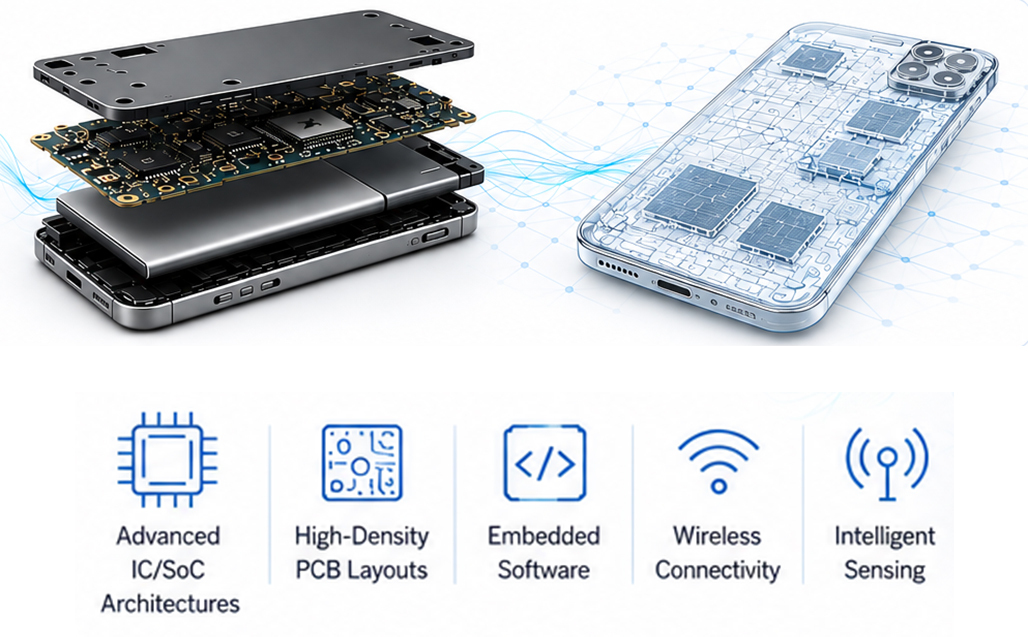
As products integrate advanced IC/SoC architectures, high-density PCB layouts, embedded software, wireless connectivity, intelligent sensing, and increasingly compact packaging, engineering complexity continues to grow across every subsystem. These elements are no longer developed in isolation; changes in one area can directly influence thermal performance, structural integrity, signal integrity, power consumption, reliability, and overall system performance.
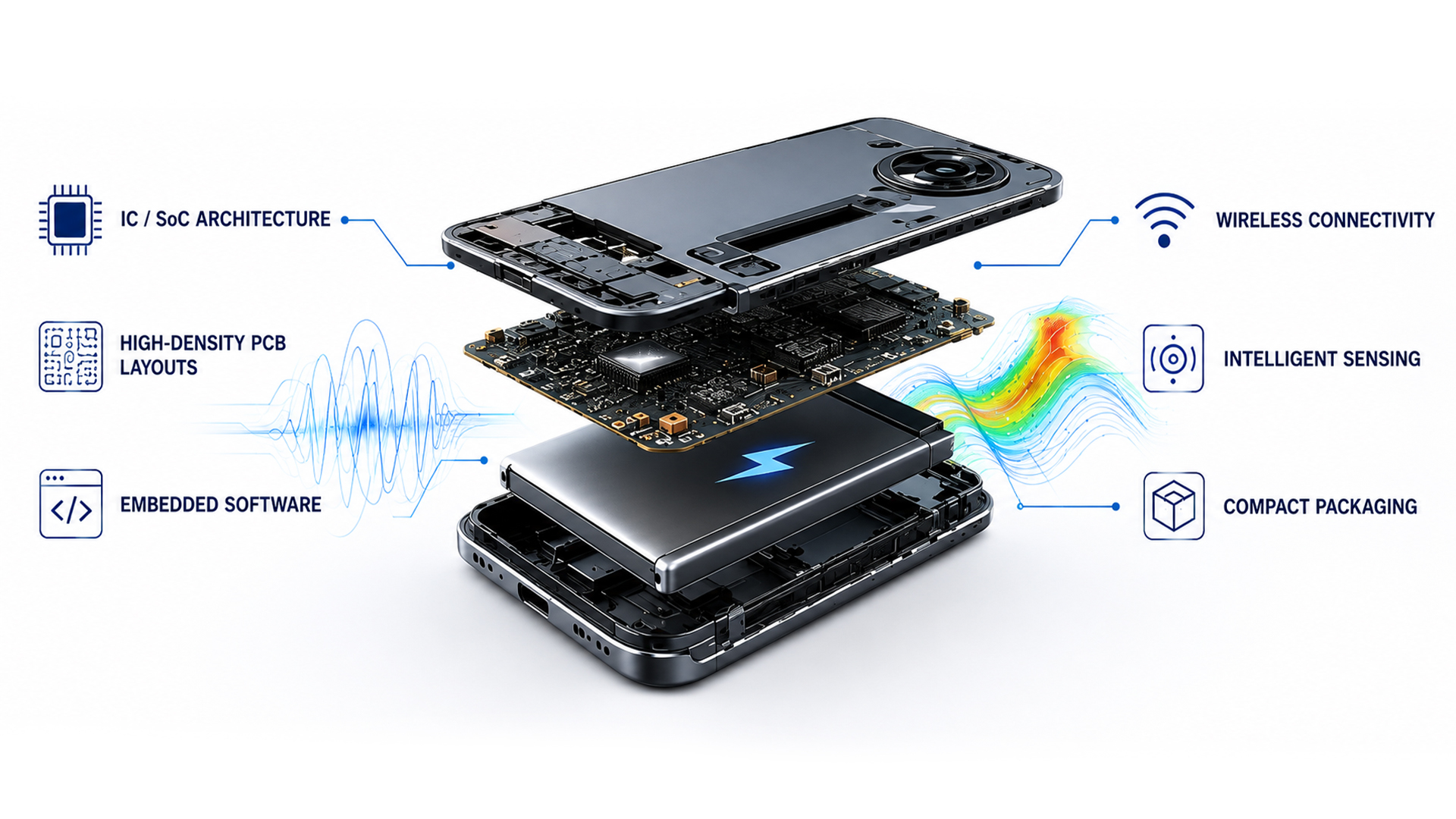
Key engineering challenges include:
• Product miniaturization increases packaging density, making thermal management, structural integrity, and signal integrity more challenging.
• Thermal management becomes increasingly critical as higher power densities are integrated into compact electronic assemblies.
• Battery optimization requires maximizing energy efficiency without compromising performance, safety, or lifecycle.
• EMC/EMI compliance demands robust electromagnetic shielding and signal integrity across high-speed electronic systems.
• Hardware-software integration requires seamless synchronization between ICs, PCBs, embedded firmware, sensors, and communication interfaces.
• Reliability validation must accurately predict vibration, drop, thermal cycling, fatigue, and environmental performance before physical testing.
• Design for Manufacturability (DFM) requires optimizing products for scalable production, assembly efficiency, and manufacturing yield.
• Regulatory compliance demands adherence to global safety, EMC, wireless, and environmental standards without delaying product launches.
• Accelerated development requires reducing simulation and prototype iterations while maintaining engineering accuracy and product quality.
These challenges cannot be solved through conventional engineering workflows alone. They require engineering intelligence that combines simulation, AI, and digital validation into a unified development process.
Engineering Better Products Before They're Built
What if your product could be validated before the first PCB is fabricated?
Modern consumer electronics demand engineering decisions long before hardware exists. As products integrate advanced IC/SoC architectures, high-density PCB layouts, embedded software, wireless connectivity, and intelligent sensing, every subsystem must be digitally evaluated to ensure performance, manufacturability, and compliance.
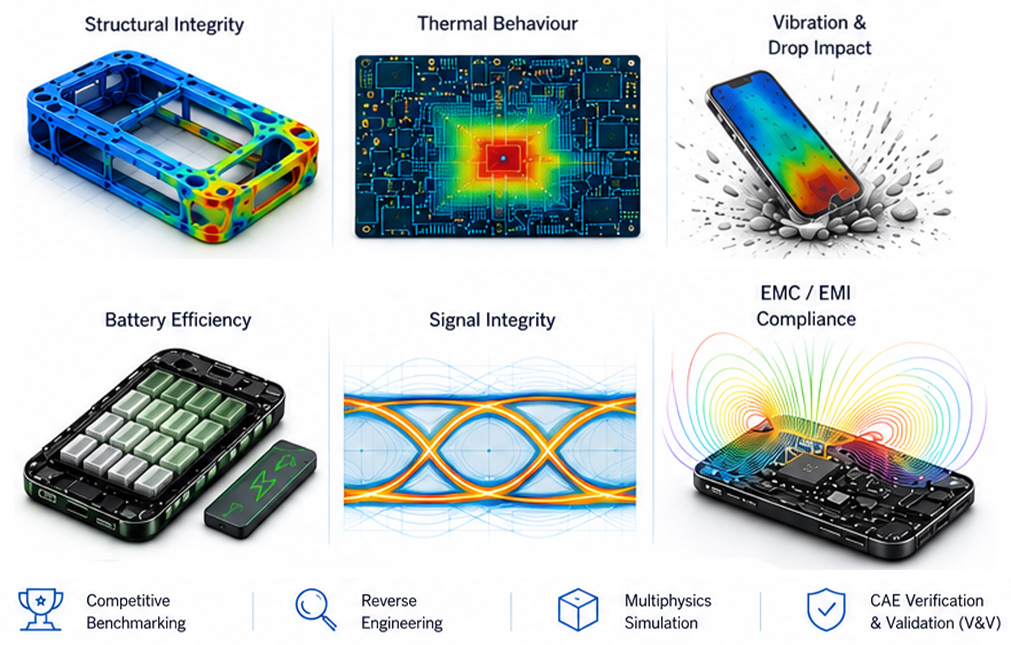
Through competitive benchmarking, reverse engineering, multiphysics simulation, and CAE Verification & Validation (V&V), engineering teams can evaluate structural integrity, thermal behaviour, vibration, drop-impact resistance, battery efficiency, signal integrity, and electromagnetic compatibility (EMC/EMI) under real-world operating conditions.
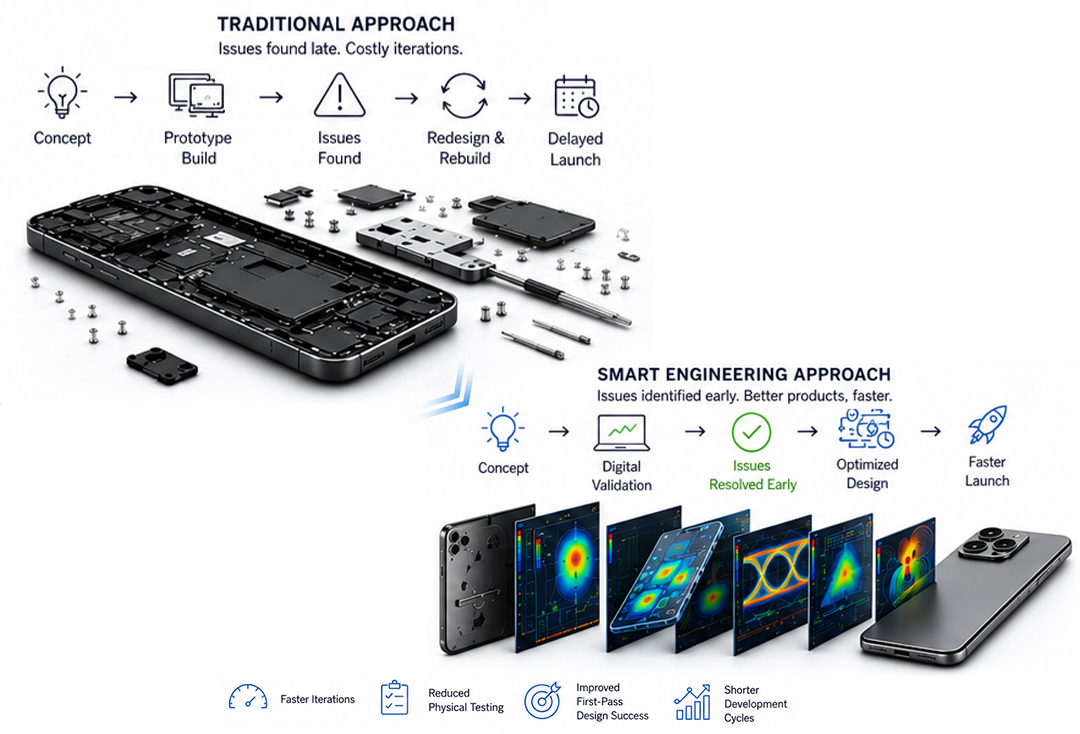
Instead of waiting for physical prototypes to reveal design issues, manufacturers can identify performance bottlenecks, optimize product geometry and materials, validate subsystem interactions, and reduce engineering risk much earlier in the development lifecycle. The result is faster iterations, improved first-pass design success, reduced physical testing, and shorter product development cycles.
DEP's Engineering Approach for Consumer Goods & Electronics
Engineering today's intelligent products requires more than traditional simulation - it demands AI-native engineering.
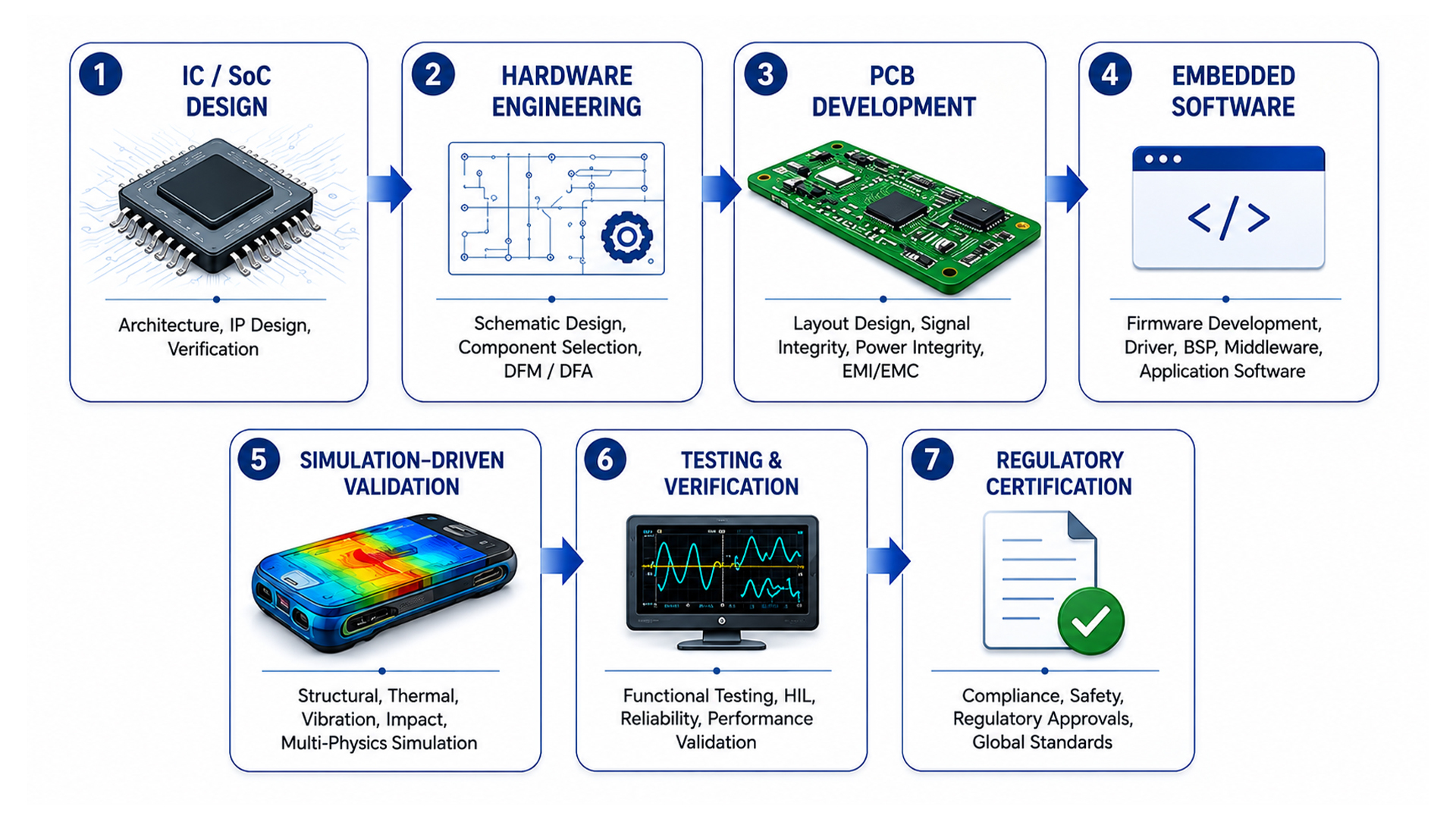
DEP supports every stage of the product lifecycle - from IC/SoC design, hardware engineering, PCB development, and embedded software to simulation-driven validation, testing, and regulatory certification. By combining deep engineering expertise with intelligent digital workflows, DEP enables manufacturers to transform engineering complexity into engineering intelligence. Unlike generic AI models, DEP employs problem-specific AI architectures tailored to distinct engineering behaviours such as structural response, thermal performance, vibration, impact events, and design optimization. Physics-informed AI embeds governing engineering principles directly into model training, ensuring predictions remain physically meaningful while improving extrapolation beyond the original training data.
DEP further enhances engineering intelligence through patented voxelisation technology, which converts geometry, thickness distributions, and material characteristics into statistically meaningful engineering features that conventional post-processing cannot capture. Confidence-aware AI evaluates the reliability of every prediction before it influences engineering decisions, while Reduced Order Models (ROMs) and scalable simulation datasets enable engineers to rapidly evaluate thousands of validated design alternatives without compromising engineering fidelity. Rather than replacing engineering expertise, these technologies amplify it - allowing engineering teams to explore larger design spaces, make faster decisions, and confidently optimize products before the first prototype is built.
Key Capabilities Offered by DEP
DEP's engineering capabilities span the complete consumer goods and electronics product lifecycle, including:
- Geometry preparation, mesh generation, and CAE preprocessing for faster and more accurate design iterations.
- AI-driven design optimization, predictive engineering, simulation automation, and intelligent engineering decision-making.
- Structural, thermal, vibration, durability, and EMC/EMI simulation across consumer electronics and embedded systems.
- Embedded hardware and software co-development for intelligent, connected products.
- Competitive benchmarking, reverse engineering, and CAE Verification & Validation (V&V).
- Digital engineering workflows that minimize physical prototyping, accelerate certification, and shorten development cycles.
- End-to-end product engineering - from concept development and embedded software to testing, validation, and manufacturing readiness.
Together, these capabilities create an integrated engineering ecosystem that helps manufacturers develop reliable, high-performance products across smart home appliances, wearables, IoT devices, telecommunications equipment, and next-generation embedded electronic systems while reducing engineering effort, development cost, and time-to-market.
Engineering the Future Together
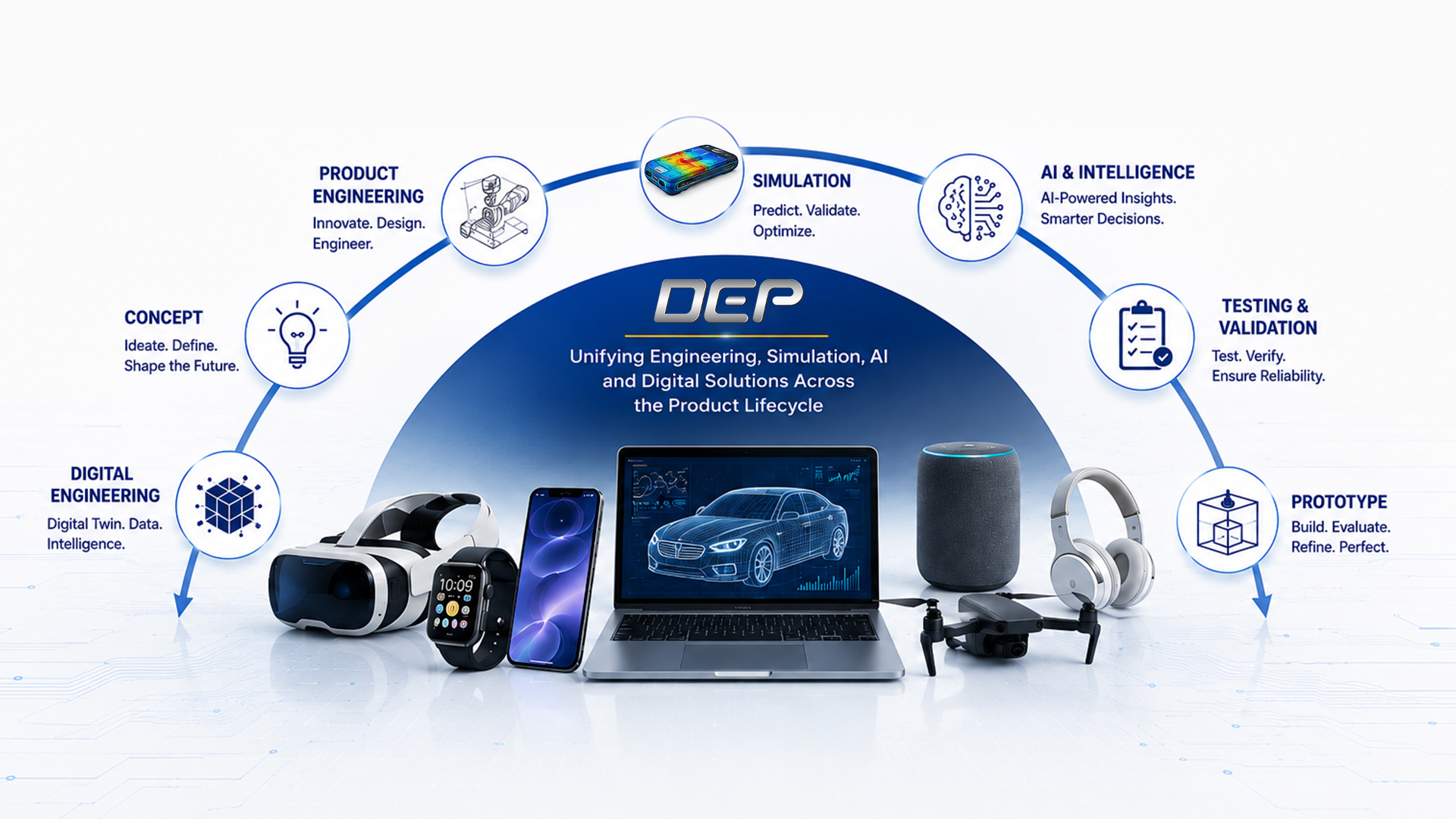
Consumer goods and electronics are becoming smarter and more connected, increasing engineering complexity across the product lifecycle. DEP unifies product engineering, simulation, AI, testing, and digital engineering to help manufacturers validate earlier, optimize performance, and reduce engineering uncertainty. From concept to production, DEP enables faster innovation and reliable, market-ready products.
What will define the next generation of consumer goods and electronics - more features, or better engineering behind every feature?
Explore DEP's Services & Solutions to discover how advanced engineering methodologies, AI-enabled digital engineering, and end-to-end product development expertise are helping manufacturers engineer the next generation of consumer products.