Your Battery Is Sending a Warning Signal - Is Your Sensor Stack Fast Enough to Hear It?
BTR Detection: Closing the Early Warning Gap in Lithium-Ion Batteries
By the time a gas sensor detects venting, a temperature sensor sees a spike, or a voltage reading looks abnormal, a lithium-ion cell's thermal runaway process is often already underway. That's not a design flaw in those sensors — it's a physical limitation of where they sit and what they measure. Every one of them is watching for a symptom of failure that shows up outside the cell, after the electrochemical damage inside it has already progressed through several irreversible stages.
DEP recently hosted a technical webinar — “Unlocking New Heights in Battery Safety” - that walked engineers through exactly where that detection gap comes from, and how DEP's electrochemical Battery Thermal Runaway (BTR) sensor closes it with a validated 12-minute early warning lead, tested across multiple abuse scenarios and battery chemistries. This post recaps the technical substance of that session - the failure chemistry, the regulatory backdrop driving urgency, the sensor architecture, and the real test data - and tells you where to watch the full recording.
The Industry Challenge: Why “Detect After the Event” Is No Longer Good Enough
Conventional battery safety monitoring is built around four sensing modalities, and each one has a structural blind spot:
- Gas sensors detect combustion or decomposition byproducts, but only after the cell has vented - meaning the thermal event has already begun.
- Temperature sensors sit outside the cell and react slowly, because internal temperatures rise well before that heat conducts through the casing to an external probe.
- Voltage monitoring fluctuates during entirely normal charge/discharge cycles, making it unreliable as an early-stage indicator and prone to false positives.
- Pressure sensors suffer from a low signal-to-noise ratio and typically require complex, chemistry-specific calibration matrices - and are still prone to false positives and negatives.
All four are, by design, outside-the-cell measurements of downstream effects. That's the core problem: they're built to catch a fire that's already starting, not the chemistry that's about to start it.
At the same time, the regulatory floor for how much warning time a battery system must provide is rising fast, and in some markets it's already law:
Region | Regulation | Core Requirement | |
|---|---|---|---|
China | GB 38031-2025 | Batteries must survive 2 hours without fire or explosion after thermal runaway onset (vs. a 5-minute standard previously), with external temperatures held ≤ 60°C, plus a 5-minute alert system with zero toxic fumes reaching the cabin. | |
Europe / Global | UN ECE R100.05 | No fire, explosion, or smoke may enter the passenger compartment within 5 minutes of the thermal propagation warning signal; the battery system must prevent propagation for 2 hours after a single-cell thermal runaway event, or meet an equivalent, documented safety verification. | |
United States | FMVSS No. 305a / 49 CFR 571.305a | Vehicles must issue a 3-minute audible-and-visual thermal event warning from the onset of a REESS (battery) thermal event, sustained for at least 5 minutes. Mandatory from September 1, 2027 (light vehicles) and September 1, 2028 (heavier vehicles). |
Two of these three mandates are already in effect. The third has a fixed compliance date less than fourteen months out at the time of writing. For any team designing a battery safety architecture today, “detect it after venting starts” is no longer a strategy that clears the regulatory bar - it's a strategy that's already behind it.
Understanding Thermal Runaway: What's Actually Happening Inside the Cell
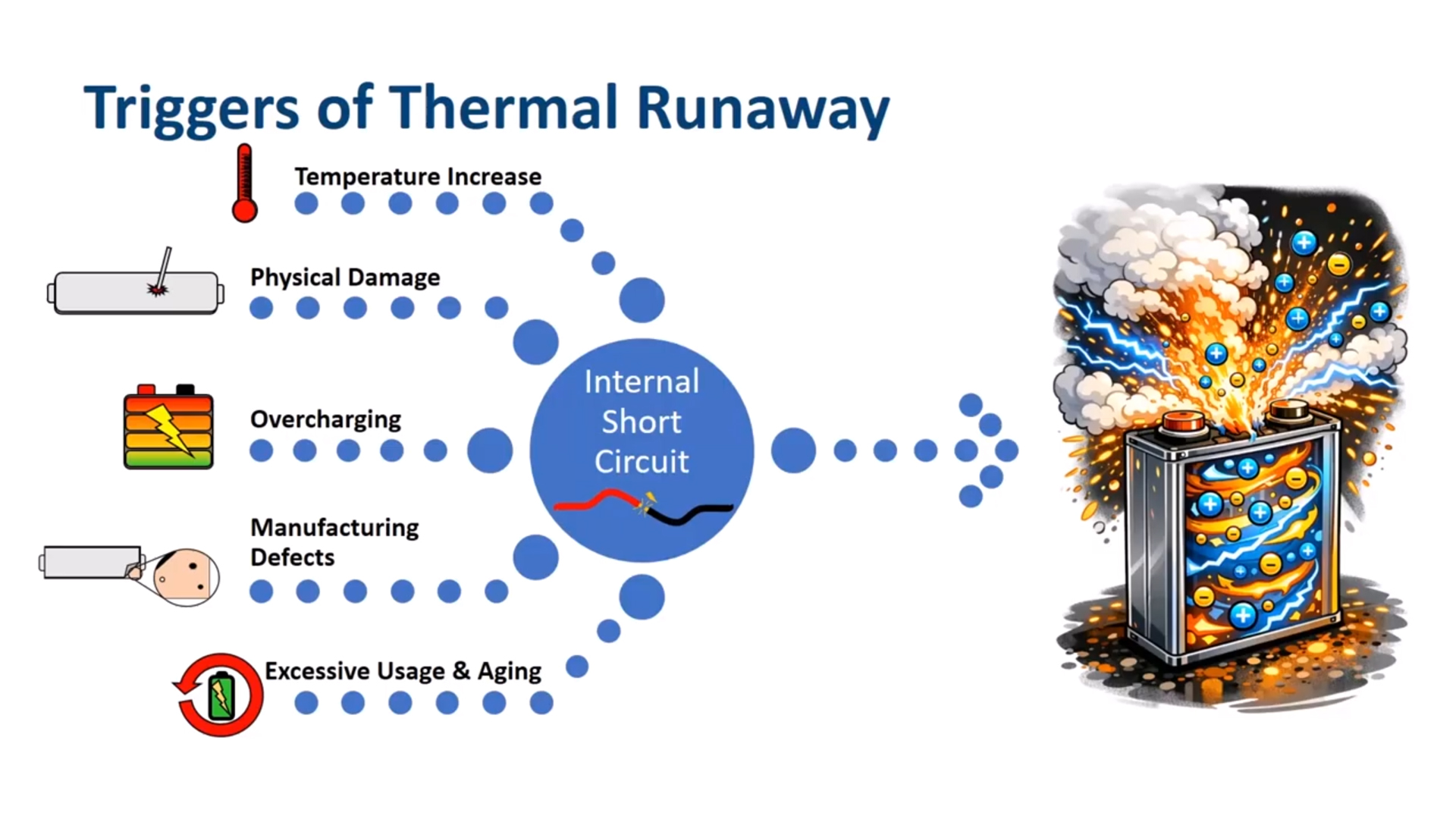
Thermal runaway rarely begins as a single dramatic event. It is typically triggered by temperature rise, physical damage, overcharging, manufacturing defects, or repeated deep cycling, which can cause an internal short circuit. Once initiated, it progresses through a well-documented chemical cascade. The sequence includes metal-ion dissolution, SEI decomposition, lithium-electrolyte reactions, separator melting, internal short circuits, safety venting, cathode and electrolyte decomposition, and ultimately combustion of the electrolyte.
The mechanism behind that cascade, at the chemistry level, looks roughly like this:
- Formation gases as the SEI layer builds, electrolyte reduction on the graphite anode produces gas dominated by C₂H₄, with minor H₂ and CO - this tapers off once the SEI stabilizes under normal operation.
- Plating and dendrite growth under fast charging or low-temperature conditions, plated lithium reacts with the solvent to generate H₂ and alkane gases, while dendrites begin growing toward the separator.
- Heating escalation, SEI and solvent byproducts decompose into CO₂, CO, and C₂H₄; the electrolyte salt (LiPF₆) begins breaking down, adding HF and POF₃ into the mix, and the reactions become self-accelerating (exothermic).
- Separator breach and internal short dendrites physically pierce the separator, triggering an internal short circuit and a rapid spike in Joule heating and multi-species gas generation.
- Venting and runaway the safety vent opens, vaporized electrolyte is ejected, and oxygen released from the cathode drives further chemical oxidation - pushing the cell into full thermal runaway.
- Temperature sensitivity all of these reaction rates increase sharply with temperature, and risk escalates significantly once a cell's internal temperature exceeds roughly 100°C, with the exact threshold depending on cell chemistry and design.
The critical insight for sensor design is where in this sequence a signal can actually be captured. The early stages — SEI decomposition and the associated surface-layer chemistry — happen while thermal runaway is still preventable. By the time gas venting, separator failure, or a measurable temperature spike occurs, the cell has already moved into the segment of the cascade where runaway can no longer be stopped, only contained.
Introducing DEP's Electrochemical BTR Sensor
DEP's Battery Thermal Runaway (BTR) sensor is built specifically to read the chemistry at that earlier, preventable stage - by sitting inside the cell rather than monitoring it from outside.
How it differs from conventional sensing, directly
Capability | DEP BTR Sensor | Conventional Sensors | |
|---|---|---|---|
Sensor location | Placed inside the cell | Placed outside the cell | |
What it detects | Electrochemical changes - reactive precursor species from electrolyte fragmentation, surface-layer decomposition, and metal species release | Downstream physical effects (heat, gas, pressure, voltage swings) | |
Detects before gas venting | Yes | No | |
Chemistry-agnostic | Yes | No - typically requires chemistry-specific calibration matrices | |
False positive / negative rate | High accuracy, no reported false positives or negatives in DEP's validation testing | Prone to false positives and negatives | |
Dependence on venting or thermal lag | Not dependent on either | Dependent on one or both | |
Scalability | Cell, module, or pack level | Partial - typically pack- or module-level only |
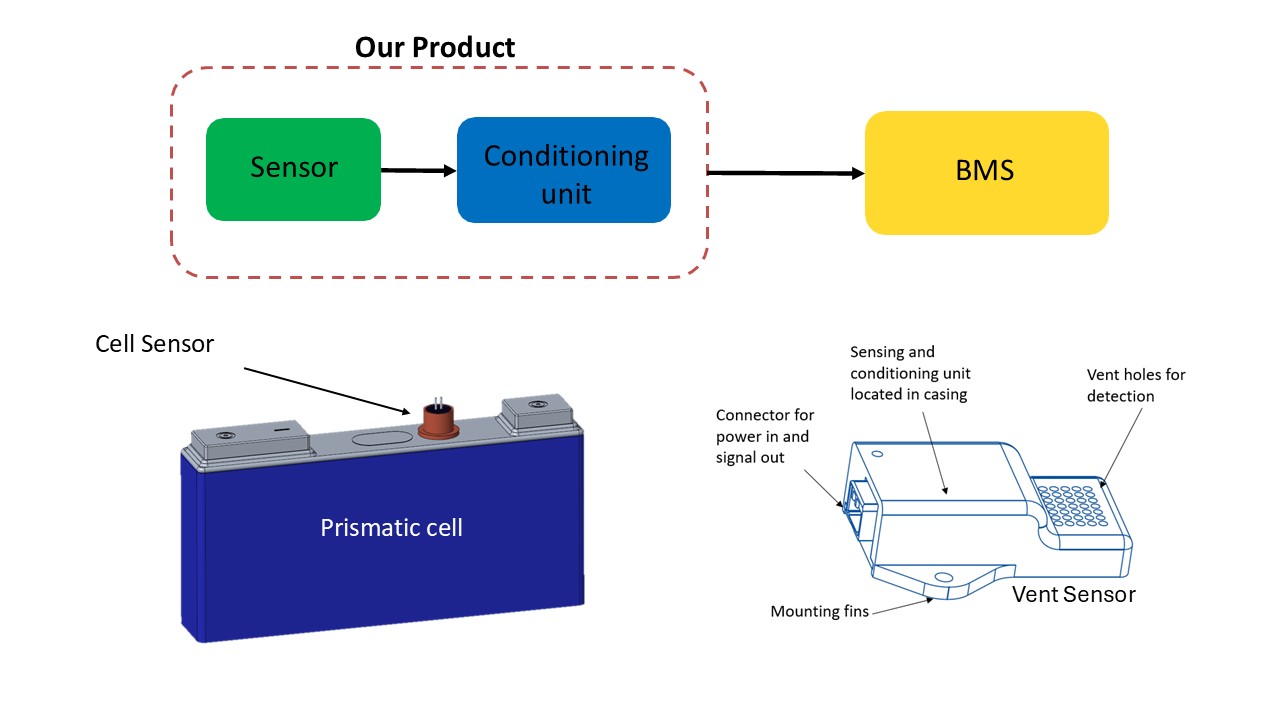
Physically, the sensor is designed to be flexible in form factor - configurations as small as a dime, either paired with an external signal-conditioning unit or packaged as a single integrated unit. It can be positioned at the vent, within ducting, inside a module, or embedded in each individual cell, depending on the application and the safety architecture the customer is designing around. In DEP's validation builds, the sensor has been demonstrated on prismatic cell form factors, wired through a conditioning unit into the battery management system (BMS) - with the added capability of visualizing flame ignition points and mapping thermal propagation within a pack as a function of time and location, which is useful for prototype-level safety validation as well as production monitoring.
Validated Test Performance: Real Cells, Real Abuse Conditions
The webinar's core technical content was a walkthrough of four validated test scenarios, run on real NMC and LMO prismatic cells rather than simulated data:
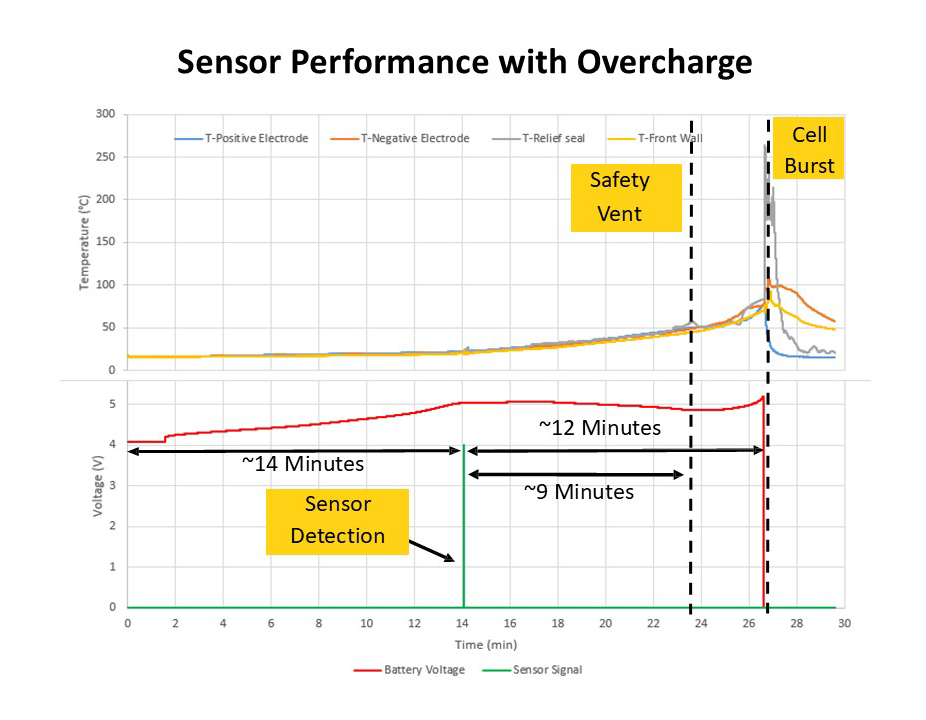
Test 1 - Overcharge (50Ah NMC cell, 4.2V, overcharged at 1C): Thermal runaway began 14 minutes after overcharging started. The sensor detected thermal runaway precursor production 12 minutes before runaway occurred — with the cell beginning to vent roughly 9 minutes after the sensor's initial detection.
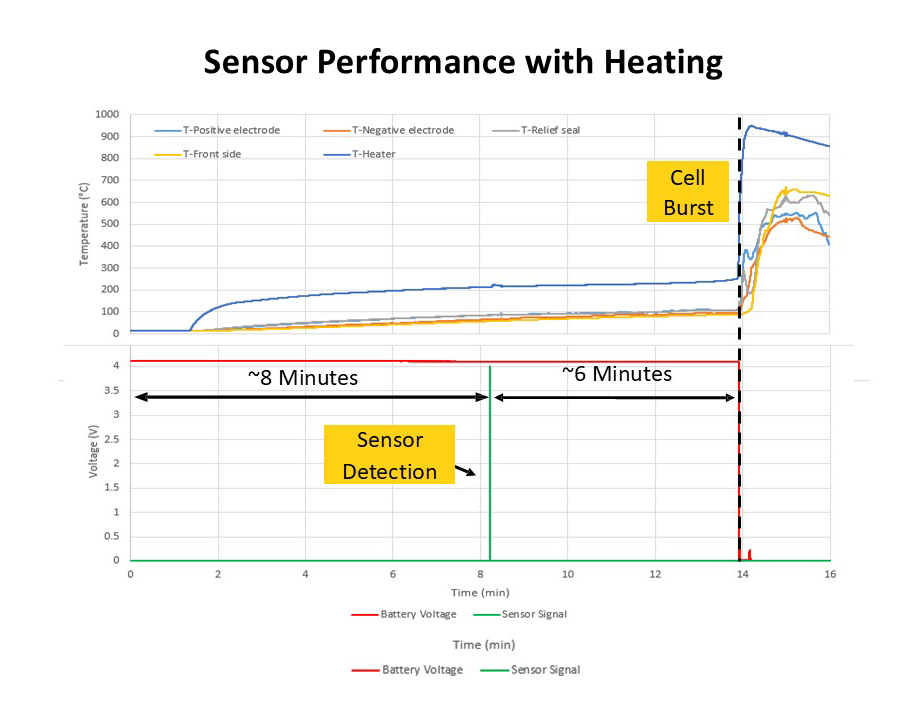
Test 2 - External Heating (50Ah NMC cell, 4.2V, 300W heater): Thermal runaway began 7 minutes after heating started, and the sensor detected precursor formation 6 minutes ahead of runaway.
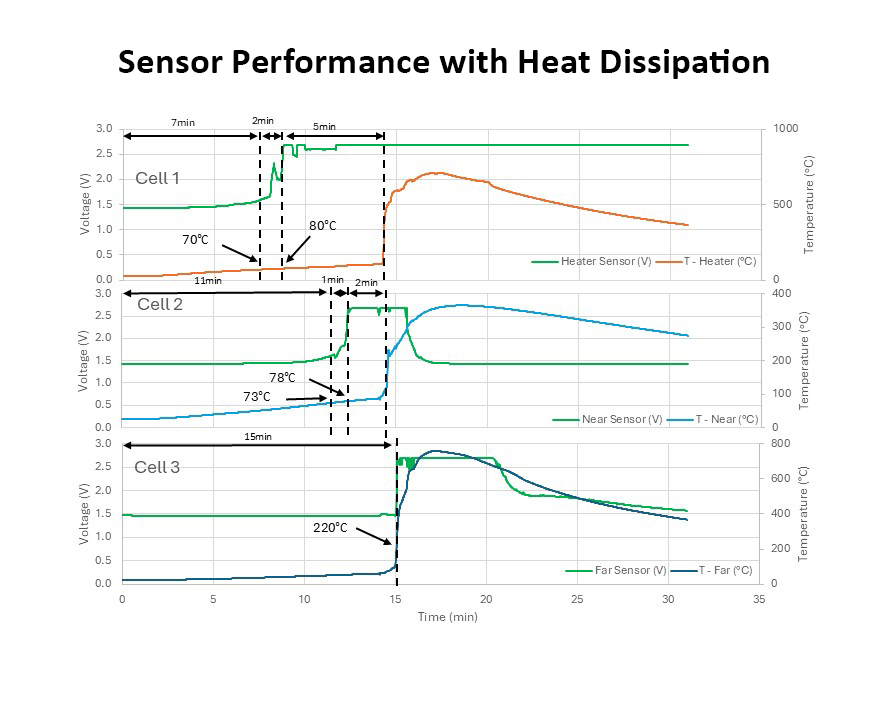
Test 3 - Heat Dissipation Across a Cell Pack (25Ah LMO cells, 4.2V, 300W heater applied to one of three adjacent cells): The sensor detected thermal runaway precursors at 7 minutes in the directly heated cell, 11 minutes in the adjacent cell, and 15 minutes in the furthest cell — correctly picking up the precursor signal generated by rising temperature conducted from the neighbouring cell, not just from direct heating.
Test 4 - Repeatability (25Ah NMC cell, 4.2V, overcharged at 0.5C across three separate cycles): The sensor reliably detected thermal runaway precursors at each of three overcharge events (roughly 40, 70, and 105 minutes into the test), and picked up the worst-case cell degradation 9.5 minutes before thermal runaway on the final cycle — demonstrating the detection isn't a one-time event but holds up across repeated abuse.
Taken together, the four tests point to a consistent pattern: detection lead time varies somewhat with abuse mode (overcharge conditions produced longer lead times than direct heating in these tests), but the sensor consistently registered a signal during the chemically preventable phase of the runaway cascade — well before venting, and across two different cathode chemistries.
Why This Matters for Engineering Teams Right Now
Pulling the technical threads together, DEP's BTR sensor offers engineering teams a few concrete advantages worth weighing against a current sensor stack:
- It's chemistry-agnostic. The same underlying detection principle (reactive precursor species from electrolyte breakdown) applies across NMC, LMO, and other lithium-ion chemistries, rather than needing a separate calibration matrix per cell type.
- It detects earlier in the failure cascade than temperature, pressure, or gas sensors, because it's reading the electrochemistry directly rather than waiting for a downstream physical effect.
- It's configurable in size and placement from a dime-sized in-cell sensor to a vent- or duct-mounted format — so it can be integrated at the cell, module, or pack level depending on the safety architecture already in place.
- It has a defined integration timeline: Roughly 16 weeks from initial requirements-gathering through sensor and circuit-board design, manufacturing, integration testing, and delivery — a scoped, plannable engineering program rather than an open-ended R&D exercise.
For teams already navigating GB 38031-2025, UN ECE R100.05, or the incoming FMVSS 305a compliance dates, an earlier and more chemistry-consistent detection signal is directly relevant to how much time is actually available to trigger a warning, initiate mitigation, or protect occupants — which is the exact metric all three regulations are now written around.
If your team is actively working through battery safety architecture, thermal runaway mitigation, or upcoming regulatory compliance — for EV, energy storage, aerospace, defense, or industrial applications — DEP is also offering customized technical sessions to walk through how BTR sensing aligns with your specific program. Reach out here: https://depusa.com/contact
Watch the Full Webinar On-Demand
The live session, led by Mr. Youssef Mansour, DEP's Project Lead for Battery Thermal Runaway Sensing, explored these topics in depth, followed by a live Q&A on integration, battery chemistry, and regulatory considerations.
Watch the video here:
https://youtu.be/4Rb52JvzIek?si=xVe3twRjXACJyMVK
The other exclusive webinar recording is being made available on DEP's official YouTube channel:
https://www.youtube.com/@DetroitEngineeredProductsUSA