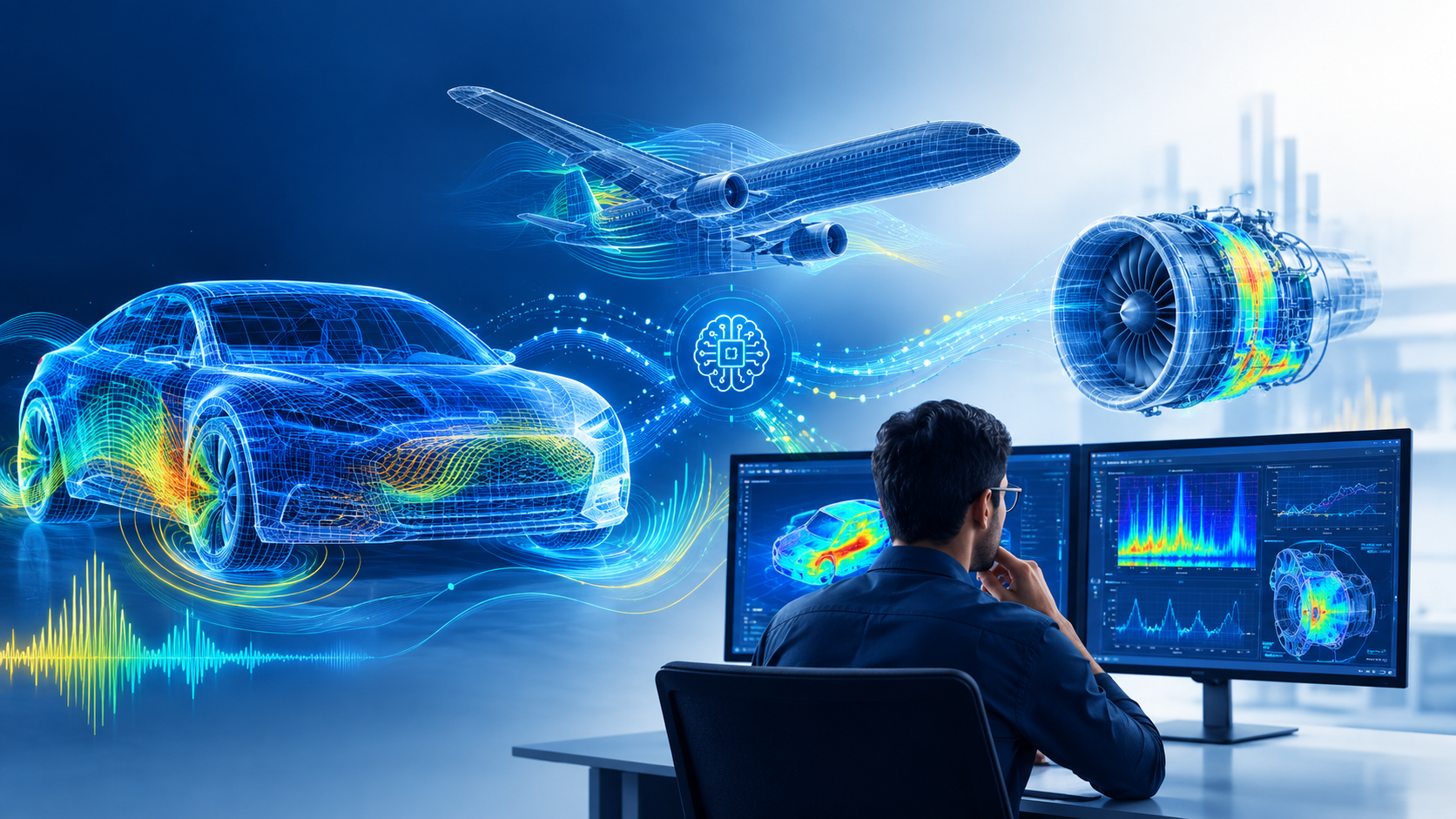
AI Powered NVH Engineering: Accelerating Noise, Vibration and Harshness Analysis
Why NVH Is a Complex Engineering Challenge
Ever wonder why some cars feel silent and solid, while others rattle and hum no matter how new they are? The difference usually isn't luck. It's physics, managed well or managed poorly.
Every vehicle is fighting a constant battle against noise and vibration. An engine firing, tires hitting rough pavement, wind pushing against the A-pillar at highway speed. Each of these sends energy through the structure. If that energy isn't controlled, it shows up as a buzz in the steering wheel, a boom at idle, or a whine under hard acceleration. When it's controlled well, you don't notice it at all. That's the goal.
Here's what makes NVH genuinely hard. It's never about fixing one noise in isolation. Stiffness, weight, powertrain behavior, road input, acoustics, and durability are all pulling against each other. Quiet down one resonance and you might add weight the program can't afford. Stiffen a mount to kill vibration and a new resonance can pop up somewhere else entirely. NVH engineering is really the art of balancing trade-offs, not eliminating them.
NVH Engineering Has a Time Problem
Here's the uncomfortable truth about NVH work: the process hasn't changed much, but the pressure around it has.
Traditionally, engineers build a full vehicle FE model, run a solver for hours or even days, review the results, tweak a gauge or a joint stiffness, and run it all over again. Now multiply that across dozens of design variants and subsystems like steering, exhaust, closures, and suspension, and you can see how fast a program timeline gets eaten alive.
And the vehicles themselves haven't gotten any simpler. Lighter structures, electrified powertrains with their own high frequency noise, and customers who expect a quieter cabin every generation. Teams are being asked to test more variants, correlate more precisely, and do it faster than ever before. The analysis still takes the same depth of work it always did. What's shrunk is the time anyone's given to do it.
DEP's NVH Engineering Foundation
So what does it actually take to speed up NVH work without cutting corners? Years of getting the fundamentals right first.
DEP didn't build its NVH capability overnight, and it wasn't built around any single tool. It's the result of years spent on full vehicle and system level work, correlating results against real test data every step of the way.
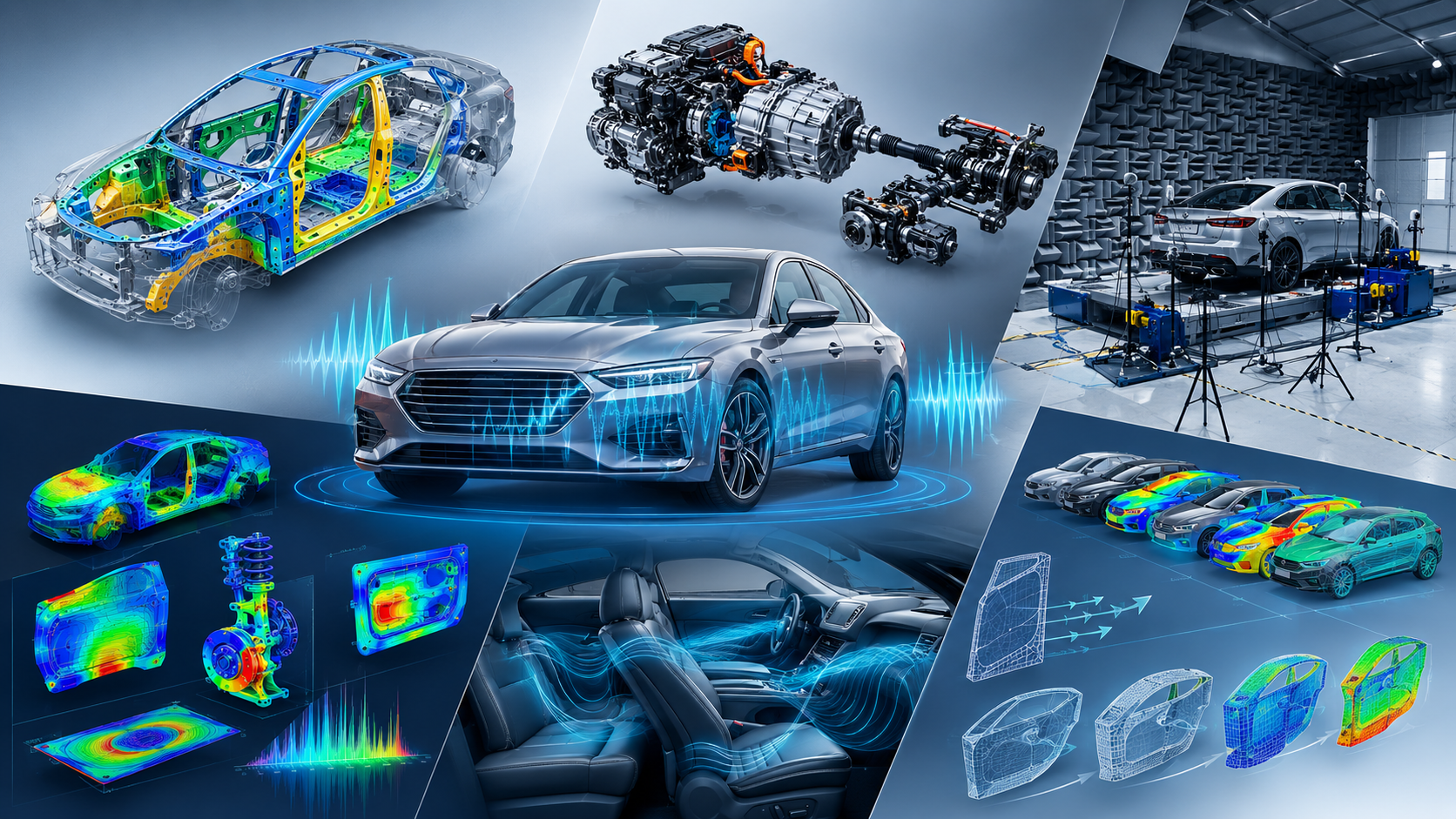
Full vehicle and subsystem depth, covering everything from trimmed body modeling to steering, exhaust, closures, cradle, suspension, and HVAC
Powertrain and high frequency expertise, including driveline imbalance, structure borne noise on motors and gearboxes, and transmission loss for mufflers, firewalls, and windshields
Core NVH capabilities like modal, FRF, dynamic stiffness, NTF, idle shake and boom, WOT, road shake, and road noise, all validated against physical testing
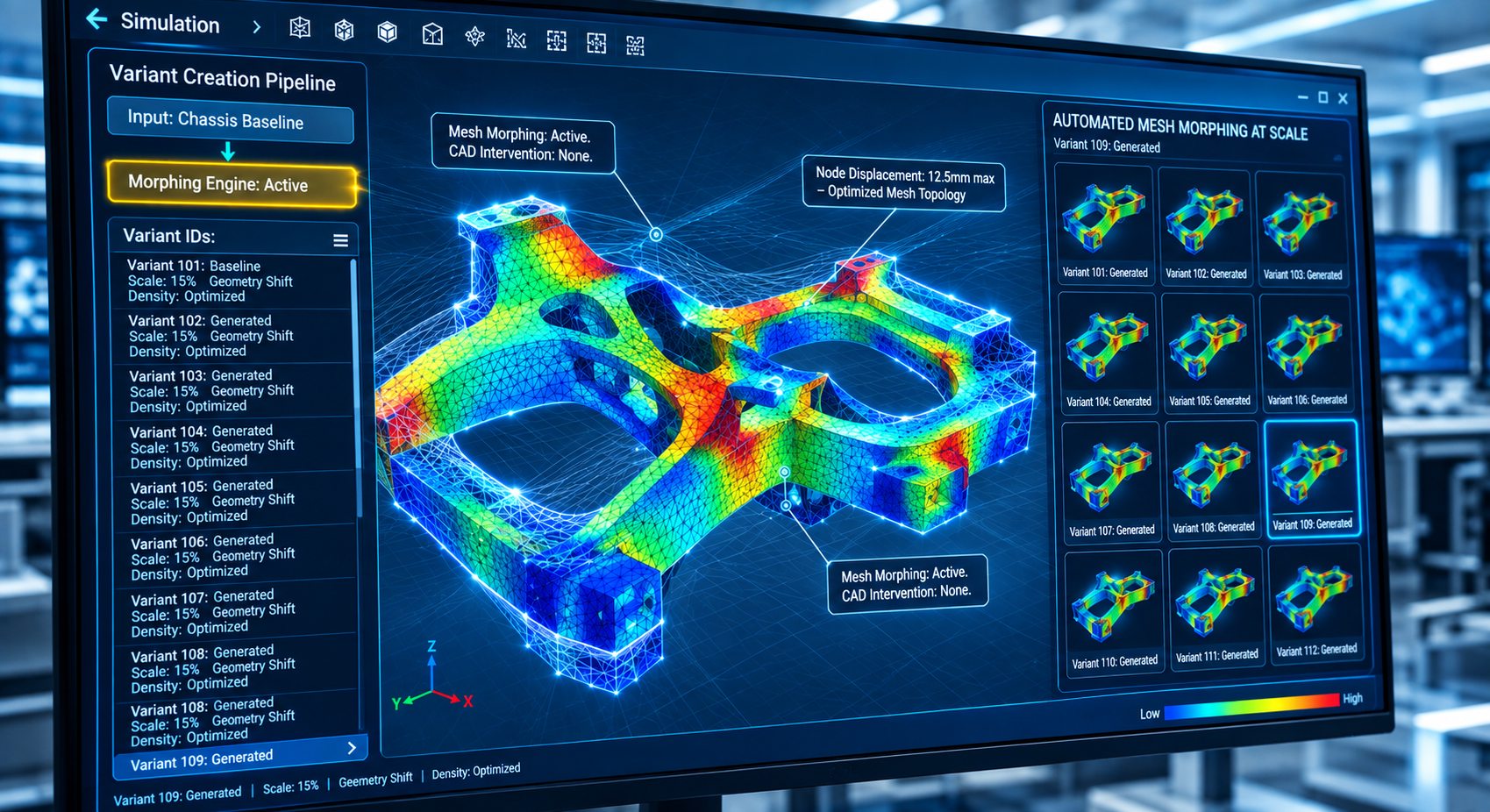
A parameterization mindset, using morphing techniques to build design variants faster than manual CAD ever could.
DEP AIWorks: Three-Stage Acceleration of NVH Analysis
AIWorks structures acceleration into three stages, each building on DEP's existing NVH capabilities:
- Generate - From one baseline model, AIWorks auto creates multiple FE variants (gauges, joint stiffness, damper rates) without manual CAD work morphing and parameterization at scale.
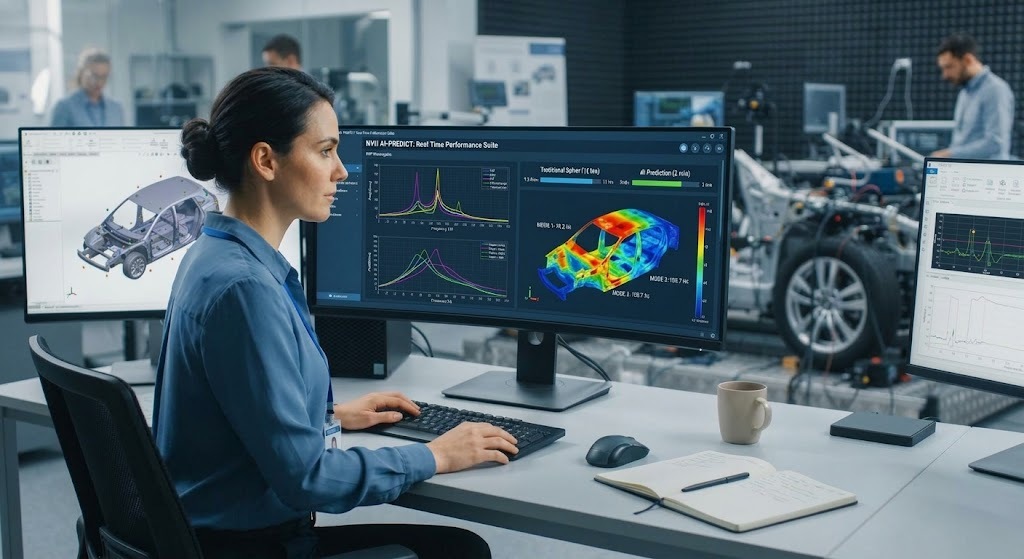
- Predict - AI rapidly estimates frequency response, modal shapes, and transfer path metrics much faster than full solver runs.
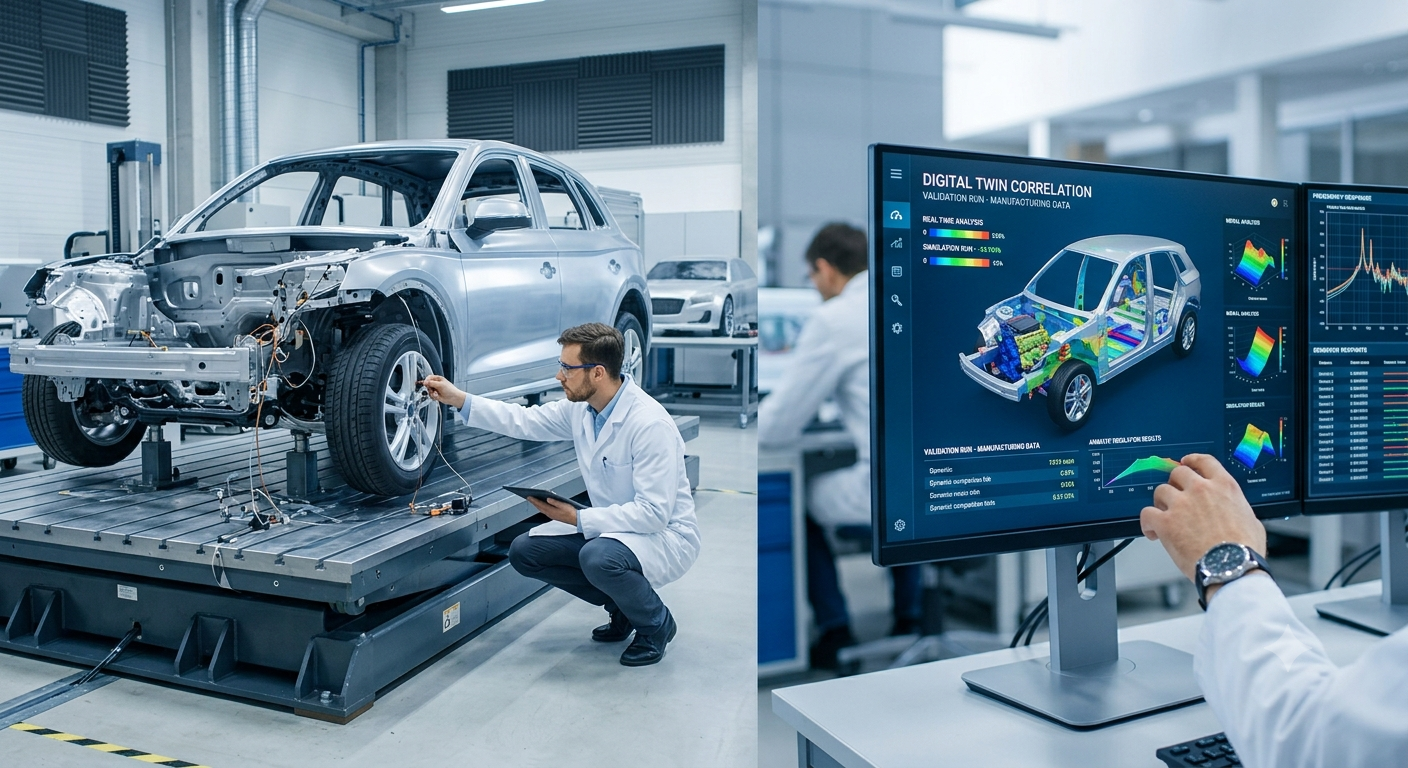
- Validate - Predictions are correlated with simulation and physical test data; a digital twin reflects real manufacturing variation, not idealized geometry extending DEP's validation work to match how vehicles are actually built.
The three stages aren't separate from DEP's existing NVH capabilities. They're those capabilities, moving faster, and covering more ground.
Technologies Behind AIWorks
Physics-Informed Machine Learning (PINNs) - embeds structural dynamics and acoustics directly into the model rather than layering predictions on afterward
Surrogate NVH solvers - trained to replicate multi-hour solver runs in seconds
Patented voxel-based data analysis - statistically compares geometry changes against NVH response across hundreds of iterations simultaneously
Generative acoustic geometry - proposes baffles, damping treatments, and reinforcements optimized directly against an NVH target
Transfer Path Intelligence - ranks bushing stiffness and mount isolation options using data rather than trial and error
Integrated Multi-Disciplinary Optimization - balances NVH targets against crash, stiffness, durability, and weight in a single loop
Industry Applications
The same underlying principles show up across every industry DEP works in, even though the specific noise sources differ.
- Automotive: EV motor and battery noise, powertrain and driveline vibration, road noise, wind noise, and transfer path work.
- Aerospace: Aircraft cabin noise, launch vehicle acoustics, satellite vibro-acoustics, and structural vibro-acoustic challenges.
- Other industries: Rail, marine, industrial machinery, and off-highway equipment, all managing how energy moves through a structure and reaches the people near it.
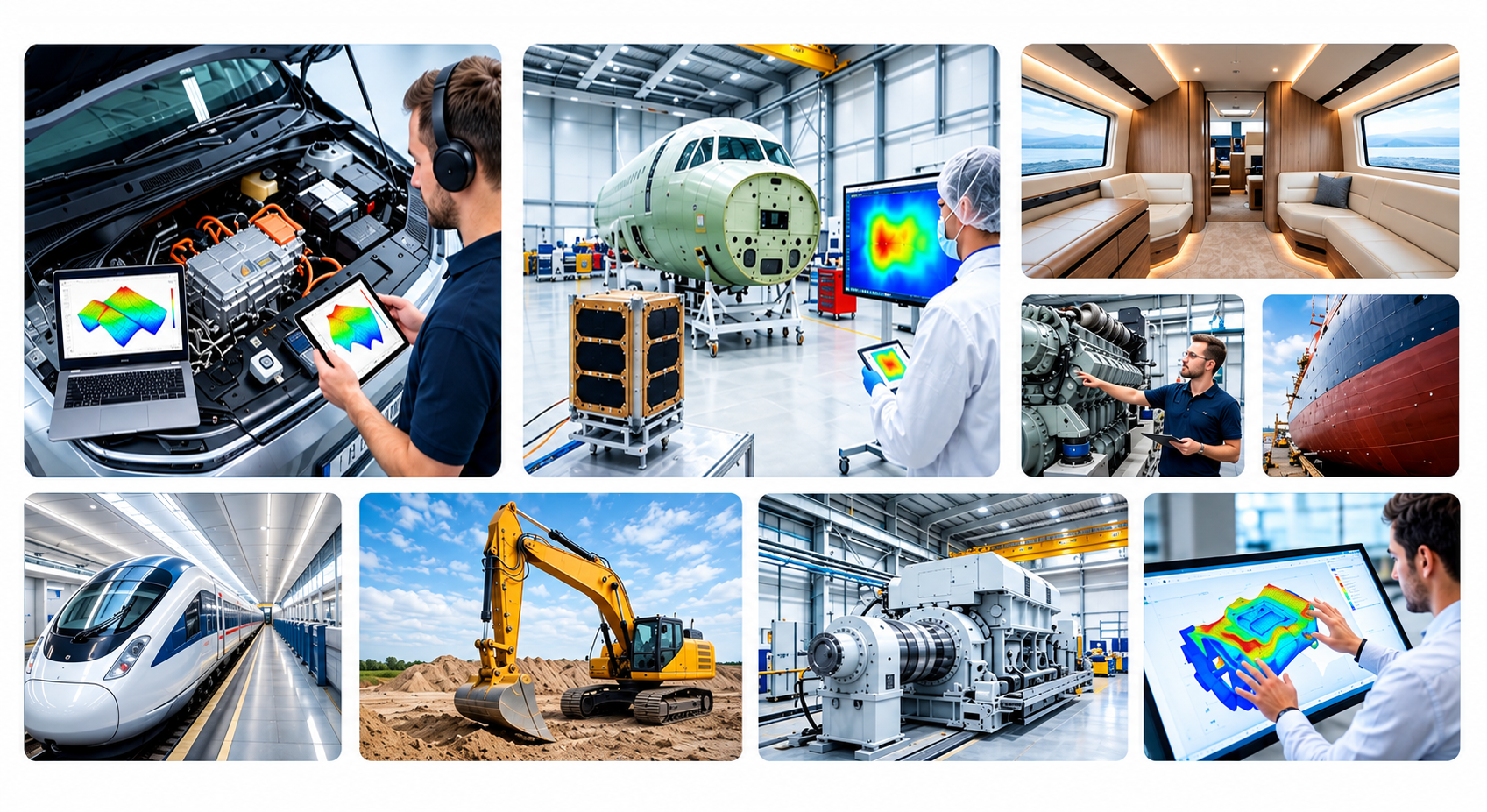
What connects all of it is that the engineering principles don't change from one industry to the next, only the hardware does. A model trained on one industry's excitation patterns can inform work in another.
What It Means for NVH Engineers?
For the people doing the work, the shift is practical rather than abstract. Repetitive analysis and parameter sweeps that used to eat up an engineer's week now run largely on their own. Design exploration happens faster, which means more options get considered before a design is locked in, not fewer.
That speed also pulls NVH decisions earlier in the programme, closer to the concept phase, before a detailed FE model even exists. And because more of that decision making can happen virtually, there's less dependence on physical prototypes to catch what should have been caught in simulation.
None of this replaces engineering judgment. AI handles the setup, the sweeps, and the correlation. Engineers still decide what the results mean, and what to do about them.
AI-Powered NVH Engineering
DEP's NVH expertise and AIWorks' AI capabilities come together to pair decades of engineering judgment with a platform that takes care of repetitive work. Think of AIWorks as an NVH engineer's co-pilot, enabling faster exploration, prediction, and optimization so engineers can focus on the decisions that matter.
If you're working through an NVH challenge in automotive, aerospace, or elsewhere, explore what AIWorks NVH can do for your programme or connect with DEP's experts to discuss it.